Showing posts with label academy awards. Show all posts

Sunday, May 18, 2014

The Lion King

File:The Lion King poster.jpgWhile the animators were slaving away on production of Pocahontas, The Disney Company needed something to placate the masses. Taking cues from the biblical tale of Joseph and Moses as well as Shakespeare’s Hamlet, the company went to work on a small project called The Lion King. Starring Matthew Broderick, James Earl Jones, Jeremy Irons, Nathan Lane, Rowan Atkinson, Whoopi Goldberg, Cheech Marin, and Jonathan Taylor Thomas, the film was Disney’s biggest successes. Making over $900 million worldwide, it became Disney’s highest grossing film until 2013. It is also the 19th highest grossing film, the third highest grossing animated film, and the highest grossing film of 1994. It won two Golden Globes, two Academy Awards, Three Annie Awards, and the Kids Choice Award for Favorite Movie and was nominated for the Saturn Awards, the British Academy Film Awards and the MTV Movie Awards. TIME named it one of the “25 All-TIME best Animated Films,” and AFI put Hakuna Matata as 99 on their  Top 100 Songs and the film as #4 on its Top 10 Animated Films. Its success earned it a Broadway Adaptation, two sequels, a midquel, a spinoff series and was featured in the Kingdom Hearts franchise.
It was also the first film I ever remember seeing. In a drive-in no less.

The film tells the story of Simba (Taylor Thomas), a lion cub who is the heir to the African Pride Lands. His uncle Scar (Irons) makes a power play for the throne, engineering the death of Simba’s father (Earl Jones). He convinces Simba that it was his fault, causing him to run away.
Dying in the scorching heat beyond the Pride Lands, he is saved by Timon (Lane) and Pumbaa (Ernie Sabella). They teach him their responsibility free philosophy and Simba grows into an adult (Broderick) with no worries. However, he meets his old friend, Nala (Moira Kelly) and he must decide whether or not to continue his life of no responsibilities or return to face his past.

Out of all the Disney Renaissance films, this one probably had the biggest production value. It’s big and beautiful in every sense of the word. There’s not one scene that draws back and takes away from any other scene. I said The Great Mouse Detective continued to top itself. But The Lion King, starts out on a huge scale and stays that way throughout the film. Even The Rescuers Down Under had a few times where it drew back to give it a bigger sensation when big scenes hit again. Putting all that together with a very adult message and relatable characters to back it up just makes the film work really well.
The message in the film is one of Disney’s most adult, which must be stated verbatim. “The past can hurt. But the way I see it, you can either run from it, or learn from it.” It’s a message that speaks to all of us, even though most of us don’t have the same past Simba experienced. But this still makes Simba one of the most relatable Disney characters. See, Simba after running away, thinks he’s finally gotten rid of his past. That is, until Nala shows up. But all he wants to do is be left alone in his carefree world. But he won’t be able to, as Rafiki shows him that he will be forever running from his past until he goes to face it. And he doesn’t do it because he wants to. He does it because he needs to.
Mufasa, even though he’s only in the film for a short while, is great. Everything he does has meaning towards the progression of the film and personifies what it means to be a great and well respected leader and father. Every time Simba is in danger, he drops everything and runs to save him. Even when it meant his own death, which was also spectacular. It says something when most Top 10 death lists include him as #1.
As a villain, Scar is pretty good and a great foil for Mufasa as a leader. Irons voices him very well. And it’s interesting to see the difference between his actions before and after he takes power. Before, he’ strategizing, manipulating, deceiving and conspiring. Like Jafar, he’s crafty and smart. But after he takes power, it all goes to his head and the lion that thought he would be a good leader turns into a childish dictator who destroys the land. He also became stupid enough to bash his minions, which led to them turning on him. Compare this to Mufasa who had the respect of the entire kingdom because of his wisdom.
The rest of the characters are great too. Timon and Pumbaa are good comedic relief that know when to get out of the spotlight, Zazu is a perfect straight man, the hyenas are great minions (with great voices) and Rafiki does really well as the shaman/wise man of the Pride Lands. He’s peaceful, but can fight with ease when he needs to.
There’s also not one song that feels out of place and the score is one of Zimmer’s best works.
On the other hand, this movie does have a fault. When Simba goes to face his past, no one is on his side until the truth comes out. If everyone hated Scar so much, why didn’t they back Simba up and give him time to explain instead of Scar going through rapid accusations?

But despite that, it’s still a great message and one of the best redemption stories put to film. #1

Wednesday, May 14, 2014

Aladdin

A hand holds an oil lamp and another rubs it, and glowing dust starts coming off the lamp's nozzle. The text "Walt Disney Pictures presents: Aladdin" is atop the image, with the tagline "Imagine if you had three wishes, three hopes, three dreams and they all could come true." scrawling underneath it.It’s hard to keep thinking of fresh, new ways to start introductions to these reviews. I don’t want to keep doing the same thing, but it’s most likely always going to be a repeat of an introduction I’ve done in the past. But oh well. Aladdin was Disney’s film for 1992. Based off the Arabian folktale from One Thousand and One Nights, the film starred Scott Weinger, Johnathan Freeman, Robin Williams, Frank Welker, Douglas Seale and Gilbert Gottfried. Earning over $500 million worldwide, its success led to two sequels, three video games, five Academy Award nominations, winning two (Best Original Score, Best Original Song: A Whole New World) and a Broadway adaptation in March. It was also one of the more annoying, yet fun worlds in Kingdom Hearts.

Set in the city of Agrabah, Aladdin (Wenger), a street urchin meets and falls in love with Princess Jasmine (Linda Larkin). However, the vizier, Jafar (Freeman), arrests him in order to acquire a magic lamp which is hidden a cave only Aladdin can enter. In it, he finds a sentient magic carpet and a genie (Williams) that he uses to win over Jasmine and defeat Jafar.

Not since Pinocchio has Disney made a film where the main character gets in so much trouble because he decided to lie. And it’s interesting to see Aladdin get deeper and deeper and deeper in his deception, especially when there’s a few times he could just tell the truth, free of consequences. But when everything unravels thanks to Jafar, it’s nice to see that he not only owns up to it, be goes and fixes what he screwed up.
And that’s what’s great about Aladdin as a character. He’s a nice guy who would rather go hungry than see children do so. And he’s always dreaming of improving his station in life. And when that actually does happen, he’s not prepared and starts becoming a polar opposite of who he really is. And when he gets that realization, it’s too late. It’s something we can all relate to in some way or another.
Aladdin isn’t the only character to go through development though. It’s a small part, but the Sultan also goes from strict and by the scroll, insisting that Jasmine marries a prince to realizing that love is better. It’s also Aladdin’s actions after the reveal that help him to see this. It’s short, it’s fast, but some development is like that.
Jafar is a good villain, especially with the sarcasm. He’s very savvy at what’s going on around him and keeps trying to edge it all into his favor. And when it doesn’t go according to plan? Develop a new plan around that. But he’s also always lusting after more and more power, which is eventually his downfall as his hubris gets in the way of him thinking about the details.

There’s also quite a bit of humor in this film. And mostly, it’s well timed and well placed. But there are a few areas where the jokes seem out of place. And they’re all from Genie. All of Iago’s comedic moments make sense due to the fact that he’s a loudmouth blowhard with no sense of subtlety. Genie, on the other hand has some moments that take away from the heaviness of the scene. I’ve said before that comedic relief is necessary to do just that, but sometimes, a heavy scene needs to be a heavy scene. #3. 

Tuesday, May 13, 2014

Beauty and the Beast

Beautybeastposter.jpgI like 1991. Mainly because it was the year I was born, but other than that, a lot of great stuff happened. The Soviet Union fell, Comedy Central was launched, the first Starbucks opened in California, and Beauty and the Beast was released to theaters. Starring Paige O’Hara, Richard White, David Ogden Stiers, Angela Lansbury, and Robby Benson, it made $399 million at the box office. It was the first animated film to be nominated for Best Picture, had three songs nominated for Best Original Song (“Beauty and the Beast” won) and won the award for Best Original Score. It also won three Grammys and two Golden Globes and The American Film Institute recognizes it as its #22 Greatest Musical, #7 animated film, #62 Greatest Song (“Beauty and the Beast”) , #34 Greatest Passions, and nominated Belle as one of their 100 Years… 100 Heroes and Villains. Eventually, it became a musical and was featured in the Kingdom Hearts franchise.


When Belle’s (O'Hara)  father doesn't return from his trip to a fair, she searches for him and finds a caste hidden in a forest. She finds her father in the dungeon and offers herself in his place. The Beast (Benson) that imprisoned him accepts.
However, he is actually a cursed human prince who hopes her love will break the enchantment on him and his servants (Stiers, Lansbury, and Jerry Orbach) . With time limited to a wilting rose, the prince must tame his temper and she must learn to see his goodness.
But the vain Gaston (White) sees Belle as his and vows to marry her.

Remember when I said the Big Ben scene in The Great Mouse Detective was the definitive use of CGI in the 1980s? Well, this film could possibly the greatest use of it in animation in the early 90s. And whenever it’s used, it looks spectacular. The “Beauty and the Beast” number would not have been nearly as good without it. Which leads me to say that this film’s production value is nothing short of amazing.
But we can’t stop there! Disney subverted “love at first sight again!” And this time, not only is it central to the story (unlike The Aristocats), but it’s actually pulled off very well, tying it into character development and a well-placed song. He went from unpleasantly mean, angry and abrasive to gentle, kind and loving and she went from being afraid of him to seeing him for who he truly is. And that’s what’s interesting. Beast wasn’t angry and abrasive because he wanted to be, it was because he hated himself. And since Belle was the first one to get past that exterior, he was able to get over himself.
Beast is also a great foil for Gaston. He starts off absolutely loving himself as God’s gift to women. And for some reason, the entire town seems to love him. He was a vain jerk that thought that since he was attracted to Belle, she should drop everything and marry him. But when it becomes clear that he’s not getting what he wants for the first time, he devolves into a complete psychopath and leads on of Disney’s greatest third acts.
And then there’s the music. I’ve mentioned two songs already and the fact that three of them were nominated for an Oscar. That’s because they’re all great songs. Except for one. See, I watched the Special Edition. And got “Human Again.” They were right to cut it out of the theatrical release as it just stops the movie dead cold for the song before picking it up again.

But if the only problem with a film is that a previously cut song is out of place, then it’s a pretty strong movie that got robbed by Silence of the Lambs. #2. 

Tuesday, April 29, 2014

Bedknobs and Broomsticks

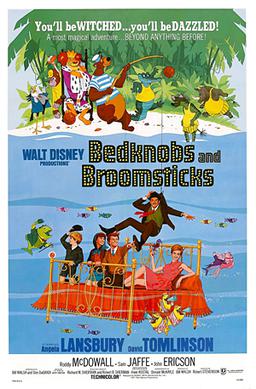
File:Bedknobs and Broomsticks poster.jpgIn 1971, Disney released another hybrid film, Bedknobs and Broomsticks. Based off the Mary Norton books The Magic Bed Knob; or How to Become a Witch in Ten Easy Lessons and Bonfires and Broomsticks, the film stars Angela Lansbury and David Tomlinson and was the last film released before Disney’s brother Roy O. Disney died. It won the Academy Award for Best Visual Effects and currently has a 66% on Rotten Tomatoes.

During the Blitz, Charlie, Carrie, and Paul (Ian Weighill, Cindy O’Callaghan, and Roy Snart) are evacuated and place in the care of the reclusive Eglantine Price (Lansbury), who is an apprentice which. She hopes her magic can bring the war to an end. After the children find out her secret, Price enchants a bedknob which will transport them to any location when attached to her father’s bed.
Price receives a letter that says her college closed down so she goes to London to speak with the headmaster Emelius Browne (Tomlinson), who is actually a con artist with meaningless formulas. Price asks him for the second book, and he produces it, but half the pages are missing. They go to Portobello Road to search for it and attract the attention of a petty thief. They are taken to the Bookman who has the other half, but the final spell is missing. The Bookman explains the author, Astaroth, used the magic to give wild animals anthropomorphism. They killed him, stole the medallion and sailed to the Isle of Namboombu.
The group heads to the island, only to learn that no humans are allowed. Browne speaks with King Leonidas (Lennie Weinrib) a soccer loving lion, who wears the Star and offers to referee an upcoming soccer match.
The king is victorious and Browne steals the star. But when they return home, the star has vanished. Paul finds the incantation for the Substitutiary Locomotion spell in his book and Price tests it. However, its power is too strong. Browne leaves as he is worried he is too attached to Price and the children.
A Nazi raiding party sneaks onto the coast, occupies Price’s house and places her and the children in a weaponry museum. Browne finds a way to join them and they use the spell on the museum’s displays and lead an army of armor to fight the Nazis. The commander destroys Price’s workshop, which knocks her off her broomstick and the army collapses. The Nazis retreat as the Home Guard fires at them.
Afterwards, Browne enlists and marches off while Paul reveals he still has the enchanted bedknob.

You may remember I said in my review of Mary Poppins that the animation was unnecessary and was only there for the sake of being animated. Well, I feel the exact opposite with Bedknobs and Broomsticks. In this film, the group goes to an island that is only thought to exist in the world of a book. And a sorcerer made the animals anthropomorphic. It could be that after a while, the animals just became animated or Asteroth simply made them that way. It’s not really explained and doesn’t need to be. The animation simply feels like it fits, which it didn’t with Mary Poppins.
The story is interesting and fun, especially with living suits of armor chanting in Latin fighting off Nazis. And the Portobello Road number shows off Disney’s casting and choreography very well. There’s a not-so-subtle moment where two prostitutes show up and even then, it’s handled very well and tastefully. I like Browne’s character arc. He first shows up as a con artist, peddling magic he doesn’t believe exists. And when he’s first presented with it, all he wants to do is market it. But when he comes to realize he’s growing fond of the children and Price, he understands how bad of an idea that is and leaves so he doesn’t grow fonder of them. But the coward found at the beginning of the film has turned noble and comes back, using the magic he once wanted to make money off of to help them and ends up joining the army. He’s got an inner conflict that everyone can relate to in one way or another.
My only problem with the film is that the children aren’t too good of actors. They’re not terrible and don’t ruin the film, but they’re just not all that great.


Final call: interesting ideas with a fun climax. Won’t make the Edge of Satisfaction, but it will become #12. 

Saturday, April 26, 2014

Mary Poppins

Marypoppins.jpgIn 1964, Disney produced a film that would be nominated for the most Academy Awards of any Disney film. Out of those 13 nominations, Mary Poppins won five: Best Actress (Julie Andrews), Best Film Editing, Original Music Score, Best Visual Effects, and Best Song (Chim Chim Cher-ee). Based on the book by P.L. Travers, the film features dysfunctional family in London visited by a magical nanny and was released August 27, 1964.

The film begins by introducing Bert (Dick Van Dyke) as a one man band who brings the viewer to the Banks household, headed by cold and aloof banker George (David Tomlinson) and airheaded suffragette Winifred (Glynis Johns). Their nanny has just quit after Jane (Karen Dotrice) and Michael (Matthew Garber) have run off. After George comes home, the constable arrives with the children. He dismisses their request to repair their kite and advertises for an authoritarian nanny, tearing up their advertisement for a fun and kind-hearted one. The remains float up the chimney.
The next day, a line of tough-looking candidates are blown away as Mary Poppins floats down via umbrella. She answers the children’s ad and hires herself. She joins the children and surprises them with a bottomless carpetbag and makes their nursery clean itself.
After meeting Bert, they enter an animated countryside, where they learn the word “supercalifragilisticexpialidocious,” and meet Uncle Albert and learn about his penchant for laughing and floating,
George is annoyed with the children’s stories but Mary Poppins tricks him into taking them to the bank. On their way, they pass the Bird Woman (Jane Darwell) who is feeding birds. They want to do so as well, but George forbids it. At the bank, he and his employers try to persuade Michael to invest his money in the bank. Michael refuses, which causes a run on the Bank. They flee and run into Bert as a chimney sweep, who takes them home, where Winifred employs him.
Mary Poppins arrives and they have another adventure on the rooftops of London, dancing with other sweeps. George arrives and asks for an explanation, which Mary Poppins replies that she never explains anything. He then receives a phone call ordering him to return.
He walks through the night streets and notices he buildings around him and the absence of the Bird Woman. At the bank he is fired and cashiered for causing the first run on the bank since the Boston Tea Party. Ordered to give a statement, he blurts out “supercalifragilisticexpialidocious, tells a joke and departs. After he leaves, Dawes Sr, the most senior partner, gets the joke and floats up in the air.
The next morning, Mary Poppins gets ready to leave and George arrives with a mended kite. A they fly it, Dawes Jr. shows up and informs that his father died laughing and reemploys George. Mary Poppins leaves the same way she came.


Hear me out and bear with me.
Those who have seen Saving Mr. Banks will remember that Travers was against the animated sequence from the beginning. That film does show her tearing up at the premiere, but in that film, it’s because George is saved. In reality, it’s because people were giving the film a standing ovation. And she completely loathed the film. But, in 1977, Travers gave an interview where she said the film was a good film, but that it didn’t do her books justice. Now, I haven’t read the books, so I can’t really judge them. But, I do agree with her on one point: the film had no need for an animated sequence. While it is a fun sequence which helps to set up one of the final acts and introduced a word in to the English language, it didn’t need to be animated. Mary Poppins is first introduced sitting in a cloud, characters fly because of laughter, children are sucked up chimneys to explore the rooftops and dance with chimney sweeps, and a crazy admiral fires a cannon twice a day. None of these have any sort of animation, why did that scene? I’m not against the children being sucked into the chalk drawing to play in the countryside and go on a fox hunt, but the sudden genre shift sticks out and feels forced. It’s not that I don’t like the animation, it’s beautifully animated, it’s just that it doesn’t feel like it belongs.
I don’t hate this film.
Mary Poppins is a truly fantastic film. The character development in the film is excellent, with every one of the Banks household being completely changed by her stay. Jane and Michael go from believing that their father hates them to understanding just how much he loves them. Winifred’s priorities shift from having the suffragette cause to the children as the most important part of her life. And then there’s George. He comes to have the epiphany that he’s been treating his work more important than his children. But it’s not just the realization that makes his role in the film so great. It’s everything about that epiphany. The way the music and cinematography combine with his character just walking to the bank is the best part of the film. The climax of that scene isn’t when he’s in the bank, but when he’s looking at the empty steps the Bird Woman once sat on and coming to realize how short life is. Hell, it’s the climax of the damn movie. Think about that. The climax of this movie is a man looking at empty steps. It’s the power of the film that makes it. It’s in that moment he truly understands everything. It just takes him until he looks at the tuppene for it to register.  I want to guess that it was nominated for Best Cinematography for that scene alone. And it should have won.
Also, Ed Wynn’s scene is one of the most forgotten parts of the film. But it’s one of the most important. If it wasn’t for that scene, the joke would never have been told and the finale would have been completely different. It takes an incredibly strong film to have its most random scene be one of the most important scenes in the film. This is why I think the countryside scene shouldn’t have been animated. Both are completely random one-scene wonders that contribute in a meaningful way to the end of the film. Only one of them was animated for the sake of having animation.
There’s no song in this film that isn’t great either. Disney said that “Feed the Birds” was his favorite song in any of his films. And it’s truly a wonderful song. I do believe it is the best song in the film and that’s a difficult choice to make. Mary Poppins’ songs vary so much in tone that merely listening to the soundtrack can give you severe mood whiplash. And that’s not a bad thing.


Final Call: Even with the forced animation, it’s still good animation. And that’s the only thing I find wrong with this film. #2

Saturday, April 19, 2014

Cinderella

Cinderella-disney-poster.jpg
After the war, Disney was over $4 million in debt and close to bankruptcy. He needed a miracle if his company was going to stay in business and figured it was time to turn back to feature film making. After two years of production, Cinderella was released February 15, 1950. A commercial success, Cinderella brought Walt back in the black and became one of the most loved Disney films ever made, making the American Film Institute’s top 10 animated films at #9. It also won the Golden Bear (Music Film) award at the first Berlin International Film Festival and was nominated for Best Sound, Original Music Score and Best Song. However, it lost to Sunset Boulevard and Captain Carey, USA.

Cinderella (Ilene Woods) is the only child of a widowed aristocrat, but after deciding that she needs a mother’s care, he marries Lady Tremaine (Eleanor Audley) and soon dies. Tremaine has two daughters from a first marriage (Drizella and Anastasia), who are envious of Cinderella’s beauty. After the death, they take over the estate and mistreat Cinderella. Despite being forced into servitude, Cinderella befriends the animals living in the barn and the mice and birds who live in and around the estate.
One day, Cinderella finds a new mouse in a trap cage, who she names Gus (Jimmy MacDonald). She gives him some clothes and tells another mouse, Jaq (MacDonald), to tell him about the cat Lucifer. They go to spy on him, but Gus eventually finds his way in a teacup meant for Anastasia. When she gets the cup, she tells Tremaine, who makes Cinderella do extra chores.
Meanwhile, the King (Louis Van Rooten) is distressed that his son does not intend to marry. However, he is determined to have grandchildren and organizes a ball for his son to find someone to marry. Every eligible maiden in the kingdom is requested to attend. Cinderella asks Tremaine, and she agress if Cinderella is able to finish her chores and find a nice dress. The animals fix a gown for her while she is doing chores and Jaq and Gus grab a sash and beads dumped by Drizella and Anastasia. They finish just as the royal carriage arrives, but when Cinderella comes down, Tremaine subtly points out the beads and sash. The stepsisters believe Cinderella stole them and rip the gown. Cinderella runs away heartbroken, but is visited by her Fairy Godmother (Verna Felton). During song, the Fairy Godmother transforms a pumpkin into a carriage, the mice into horses, the horse into a coachman, and the dog into a footman. She leaves with a warning that the spell will break at midnight.
At the ball, the prince (William Phipps) reject every girl until he sees Cinderella. The two fall in love and dane until midnight. He tries to get her name, but Cinderella flees and drops one of her glass slippers. After her clothes revert to normal, she reminisces about the dance and the mice point out the other glass slipper is still on her foot. Back at the castle, the Duke tells the King they couldn’t find her, but plan to find the owner of the slipper they recovered.
The next morning, the King proclaims the Grand Duke will visit every house in the kingdom to find the girl whose foot fits the glass slipper so she can marry the Prince. News reaches Cinderella’s estate and she hums the song played from the ball. Lady Tremaine realizes she saw Cinderella at the ball and locks her in her attic bedroom.
The Duke arrives, but the slipper doesn’t fit the stepsisters. The mice help Cinderella escape and she appears just as the Grand Duke is about to leave. Tremaine trips the footman, causing him to drop and shatter the slipper. He laments that the King will be furious, but Cinderella produces the other slipper, which he slides onto her foot. Cinderella and the Prince soon marry and the story ends as they leave in their wedding carriage.

It’s thanks to this movie that Disney turned into the giant it is today. And the credit is rightly deserved. It’s a wonderful story about dreams and faith alongside some beautiful animation. Most of the characters are believable as well. Lady Tremaine is the perfect sociopath, willing to do anything to further herself and the stepsisters are portrayed well as children of that sociopath. On the other end of the spectrum, Cinderella is always faithful and hopeful, but is relatable in how she nearly loses it when everything starts to crash down. And there’s the music, which is just spectacular. I mentioned in my review of Pinocchio that “When You Wish Upon a Star” was practically made Disney’s theme song. Well, “A Dream is a Wish Your Heart Makes” more or less became the secondary leitmotif for the Disney Company (Musicians, if I’m using that wrong, let me know). Bibbidi-Bobbidi-Boo also should have won that Oscar.
On the other hand, while the mice are entertaining, their voices an get a little grating, but that doesn’t detract from the quality of the film. Their song isn’t terrible and Jaq and Gus provide excellent comic relief.


Final Call: Damn near perfect. #1

Monday, April 14, 2014

Song of the South

In 1946, Disney would produce a film that would eventually be banned in the United States. Based on the Uncle Remus stories collected by Joel Chandler Harris, Song of the South was Disney’s first film using live actors for the frame (Fantasia using musicians) of several animated sequences. Starring James Baskett, Bobby Driscoll, Luana Patten, Glenn Leedy, Ruth Warrick, Lucile Watson, Hattie McDaniel, Johnny Lee and Nick Stewart, the film features Uncle Remus, a former slave relating to children the folk tales of Br’er Rabbit and his pursuers. “Zip-a-Dee-Doo-Dah” also won the Academy Award for Best Song.

The film begins as Seven-year-old Johnny is excited about a vacation at his Grandmother’s Georgia plantation. But when he arrives, he discovers that his parents will be living apart while his father returns to Atlanta to continue his controversial editorship of the city’s newspaper. Johnny is distraught because his father has never left him or his mother before. He leaves that night for Atlanta with a bindle, but he his distracted by the voice of Uncle Remus telling tales of a character named Br’er Rabbit. Curious, Johnny hides behind a tree to spy on a group of people sitting by a fire. By thi time, word has gotten out that Johnny is gone and some plantation residents ask if Uncle Remus has seen him. He replies that he is with him and catches up with Johnny. He befriends the boy and offers him food for the journey, taking him back to his cabin.
As Uncle Remus cooks, he mentions Br’er Rabbit again and Johnny asks him to tell more Remus tells a tale about Br’er Rabbit’s attempt to run away from home. Johnny take the advice and lets Remus take him back to his mother. In the meantime, Johnny makes friends with Toby, a little black boy who lives on the plantation and Ginny Favers, a poor white neighbor. However, Ginny’s two older brothers, Joe and Jake bully Johnny and Ginny. When she gives Johnny a puppy, Ginny’s brothers want to drown it and a rivalry develops between the boys. Johnny’s mother won’t let him keep the puppy, so Johnny takes the dog to Uncle Remus who take the dog and tells Johnny and Toby a tale of Br’er Rabbit and the Tar Baby, stressing that people shouldn’t go messing around with something they have no business with in the first place.
Heeding the advice of how Br’er Rabbit used reverse psychology on Br’er Fox and Br’er Bear, Johnny begs the Favers brothers to not tell their mother about the dog. They do and get punished, which makes them vow revenge. They go to the plantation and tell Johnny’s mother, who is upset that Remus kept the dog. She orders him not to tell any more stories. Johnny’s birthday arrive and he picks up Ginny to take her to his party. Her mother has used her wedding dress to make Ginny a dress for the party, but Joe and Jake pick another fight  and Ginny ends up in a mud puddle. Her dress is ruined and she refuses to go to the party. Johnny attacks the boys and when Remus breaks up the fight, he goes to comfort Ginny. Remus schools the brothers and tells them not to pester Johnny and Ginny anymore. Johnny doesn’t want to go to the party either since his father won’t be there. Remus discovers the two children and cheers them up by telling them about Br’er Rabbit’s Laughing Place.
Remus returns to the plantation with the children and Johnny’s mother meets them on the way and is angry at Johnny for not having attended his own birthday party. Ginny mentions that Remus told them a story and Johnny’s mother warns him not to spend any more time with Johnny. He packs his bags and leaves for Atlanta. Seeing Remus leave from a distance, Johnny tries to get to him and takes a shortcut through the pasture, but is attacked by the bull. Johnny’s father return and reconciles with his mother, but Johnny calls for Uncle Remus who has returned due to the commotion. He comes to the boy and tells a tale of Br’er Rabbit and the Laughing Place which gives Johnny the strength to survive.
Johnny, Ginny, and Toby are seen a while later skipping along and singing “Zip-a-Dee-Doo-Dah” while the puppy runs alongside them. Remus is in the area and is shocked when Br’er Rabbit and other characters from his stories appear and interact with the children. He joins the group and they skip away.

This was the film that gave the NAACP fits and eventually pressured The Walt Disney Company to ban it in the 1980s. The organization complained that the film portrayed an “Idyllic master-slave relationship.” Others also blasted the film for the same reason. This might be an error on the film’s part as it never clarifies that it is set in Reconstruction Era south instead of Antebellum. But it is also the mistake of those who complained that they never bothered to fact check with Disney. Therefore it is a mistake on the part of both parties. Maybe Disney should have done what the Hays Office had asked and to mention that the film takes place in the 1870s.
Anyway, for Disney’s first live action dramatic film, it isn’t really all that bad. Sure the cinematography is terrible at times, and Johnny and Ginny can get annoying in certain spots, but the story is still quite interesting and Uncle Remus is a fascinating character. But then, no one really watches Song of the South for the frame.
The animated parts of the film are vibrant and beautiful and each segment does well with each individual story. Br’er Rabbit’s cunning and ability to hoodwink Br’er Fox is always fun to watch as is Br’er Bear’s stupidity. The problem is that there isn’t enough animated segments. Sure the film would have run longer, but it would have been worth it.
“Zip-a-Dee-Doo-Dah” is also the only part of the soundtrack worth remembering.


Final Call: an ok frame story but great animated sequences I’m just glad I don’t have to write “Br’er again. It finds itself under The Three Caballeros at #5. 

Thursday, April 10, 2014

Bambi

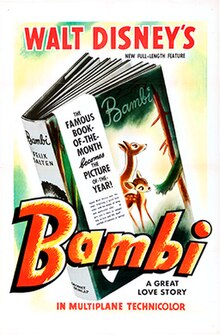
Walt Disney's Bambi poster.jpgWhen Disney decided to make a coming of age story, he wound up with the 1942 film Bambi, based on the book Bambi, I Life in the Woods. Featuring a deer growing up in the forest and befriending a rabbit and skunk, Bambi won the Academy Award for Best Sound, Best Song and Original Music Score.

The film begins as a doe gives birth to a fawn, who she names Bambi. His father is the Great Prince of the Forest who guards the woodland creatures from the dangers of man. Bambi is quickly befriended by an energetic rabbit named Thumper, a sunk named Flower and a female fawn named Faline. As Bambi asks about the world around him, he grows attached to his mother who cautions him about the dangers of life in the forest.
During Bambi’s first winter, his mother is shot and killed by a hunter while helping him find food. The Great Prince leads Bambi home. Many years later, Bambi has matured into a young stag and his childhood friends have entered adulthood as well. They are warned of Twitterpation by Friend Owl and that they will eventually fall in love. They treat the concept of romance with scorn, but Thumper and Flower both encounter romantic counterparts and change their minds. Bambi also encounters Faline and begin courtship, which is interrupted by an older stag named Ronno, who attempts to force Faline away from Bambi. Bambi successfully manages to defeat Ronno in battle.
Bambi is soon awaked by the smell of smoke and is warned of a wildfire by his father. The two flee to safety, but Bambi is separated from Faline. He searches for her and finds her cornered by hunting dogs. He wards them off and makes it to his father with Faline on a riverbank. The following spring, Faline gives birth to twins under Bambi’s eye as the new Great Prince of the Forest.

Bambi is a great film in many aspects. The animation can be drab or colorful depending on the scene, which works with the film taking place in a forest that changes with the seasons. There’s also not a lot of dialogue in the film, but the film does well in conveying emotion and story without it. Also, not having man appear in the film at all gives it greater tension. The music is also the film’s strongest point, which might be why it won those awards. “Little April Showers,” which plays when Bambi witnesses his first rainstorm is one of the best scenes. And where Dumbo failed in pacing, Bambi excels. Making it shorter would have ruined it and making it longer would have been unnecessary.
The only negative aspect was that Thumper could sometimes get annoying. But that didn’t happen often.  


Final Call: Great film with great storytelling and music. Some minor annoyances, but that doesn’t do any disservice. It easily surpasses the Edge of Satisfaction and stops at #2.

Monday, March 31, 2014

Pinocchio

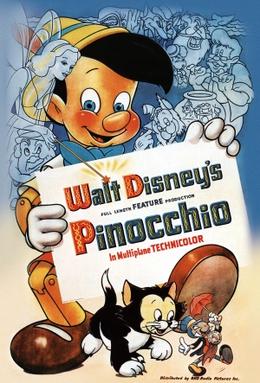
File:Pinocchio-1940-poster.jpgAfter the success of Snow White and the Seven Dwarfs, Disney decided to make another full length animated feature. In 1940, Pinocchio, based off of Carlo Collodi’s children’s novel The Adventures of Pinocchio was released. Starring Cliff Edwards, Dickie Jones, Christian Rub, Mel Blanc, Walter Catlett, Charles Judels, Evelyn Venable, and Frankie Darro, it became the first animated feature to win an Academy Award: Best Music, Original Score and Best Music, Original Song for “When You Wish upon a Star.” It was, however, a box office disaster, only making a profit in its 1945 reissue.

After singing “When You Wish upon a Star,” Jiminy Cricket explains that he is going to tell a story of a wish coming true. It begins in the Tuscany workshop of a woodworker named Geppetto. Jiminy watches the man finishes work on a wooden marionette whom he names Pinocchio. Before falling asleep, Geppetto makes a wish on a star that Pinocchio could be a real boy. During the night, the star, in the form of a Blue Fairy visits the workshop to grant Geppetto’s wish. She gives Pinocchio the breath of life, although he still remains a puppet. The fairy informs Pinocchio that if he desires to become a real boy of blood and flesh, he must prove himself to be brave, truthful, and unselfish and able to tell right from wrong by listening to his conscience. Pinocchio does not understand what a conscience is, so Jiminy appears to explain it to him. The Blue Fair asks if Jiminy would serve as Pinocchio’s conscience. He accepts.
Geppetto discovers that his wish has come true and is filled with joy. However, on his way to school, Pinocchio is led astray by Honest John the Fox and Gideon the Cat. They convince him to join Stromboli’s puppet show, despite Jiminy’s objections. Pinocchio becomes Stromboli’s star attraction as a marionette who can sing and dance with no strings while performing with Dutch girls, French can-can girls, and Russian Cossacks. However, when Pinocchio wants to go home for the night, Stromboli becomes angry, locks him in a birdcage threatens him to perform around the world and warns him that when he grows too old, he will chop him into firewood. Jiminy arrives to see Pinocchio and is unable to free him. When the Blue Fairy appears and asks Pinocchio why he disobeyed Geppetto, Pinocchio invents a story in order to hide his shame. With each lie, his nose grows even longer and the Blue Fairy explains that a lie will keep growing and growing until it’s as plain as the nose on his face. Pinocchio vows to be good from now on and the Blue Fairy restores his nose back to its original form and sets him free, warning that this will be the last time she helps him as Pinocchio and Jiminy escape.
Meanwhile, across town, Honest John and Gideon become acquainted with a coachman who promises to pay them big money if they can find him stupid boys to take to Pleasure Island. They convince Pinocchio that he is sick and the only cure is to go there as a vacation. There, he befriends Lampwick, a misbehaved disillusioned boy. With no rules or authority to stop them, Pinocchio and the other boys enjoy gambling, smoking, drunkenness, and vandalizing. Jiminy becomes angry when he discovers that Pinocchio is friends with Lampwick and storms off. Later, Jiminy discovers that the island harbors a terrible curse which the Coachman used to manipulate boys into making jackasses of themselves and becoming real donkeys. Selling them to working the salt mines and circuses. Jiminy runs back to warn Pinocchio only to find Lampwick transformed into a donkey. Pinocchio manages to escape with only a donkey’s ears and tail
Upon returning home, Pinocchio and Jiminy find the workshop empty and learn from a letter by the Blue Fairy disguised as a dove that Geppetto went to sea to look for Pinocchio. There, he was swallowed along with his cat Figaro and goldfish Cleo by the giant whale named Monstro. They are now living in his belly. Determined to rescue his father, Pinocchio jumps to the bottom of the ocean with Jiminy. He is soon swallowed by Monstro and reunited with Geppetto. Pinocchio devises a plan to excape by burning wood in order to make Monstro sneeze. The plan works, but the whale gives chase and smashes their raft. Pinocchio refuses to abandon Geppetto and pulls him to safety in a cave under a cliff before Monstro rams into it. They wash up on a beach, but Pinocchio is dead.
Back home, the group mourns for him. However, the Blue Fairy decides that Pinocchio has proven himself brave, truthful, and unselfish, and he is reborn as a real human boy. Geppetto and Pinocchio dance around the workshop to celebrate while Jiminy steps outside to thank the Fairy. He is rewarded with a solid gold badge that certifies him as an official conscience.

While Pinocchio was not originally a great financial success, the film ages fairly well. It’s a great story proving one’s worth. It may delve into dark situations and be a little heavy handed at times, but doing so works with the overall story. It shows just what Pinocchio has gotten himself into and how far he is willing to go to reverse his situation. And while the animation isn’t quite as good as Snow White, it’s still impressive.
Something must also be said about the music, since Disney has pretty much made “When You Wish upon a Star” its theme song. It’s a great song and deserved the Academy Award. It’s also the best song on the soundtrack. Most of the others aren’t bad either. The only one that seemed unnecessary was “Little Wooden Head,” in the beginning.
There’s also a few minor problems. Jiminy Cricket is supposed to be leading Pinocchio down the straight and narrow as his conscience, but he flirts with every woman he sees, including fish. It’s funny, but gets old. The Blue Fairy says she can no longer help him after rescuing him from Stromboli. Then why does she fly by and drop the letter? Did she write it or was she just a messenger. And if she was just a messenger, who wrote it and how did they know where Geppetto was? Also how does a wooden puppet without lungs drown?
By now I’m just nitpicking. Pinocchio is an excellent film.


Final Call: Pinocchio delivers a great story with mostly good songs. It surpasses the Edge of Enjoyment and becomes #2 under Snow White. 

Wednesday, March 5, 2014

Casablanca

[ CASABLANCA POSTER ]Based on the unproduced stage play, Everybody Comes to Ricks, Michael Curtiz’ 1942 film Casablanca was nominated for eight awards, winning Best Picture, Best Director and Best Screenplay. Starring Humphrey Bogart, Ingrid Bergman, and Paul Henried, the film features a man who must choose between love and virtue.

The film begins in December 1941, where American expatriate, Rick Blaine (Bogart) is the proprietor of Rick’s CafĂ© Americain, a nightclub and gambling den in the Moroccan city of Casablanca.  The cafĂ© attracts a variety of people: Vichy Frency, Itallian, and German officials alongside refugees who are desperate to reach the United States. Rick professes to be neutral in all matters, but ran guns to Ethiopia during the war with Italy and fought against the Nationalists during the Spanish Civil War.
The petty criminal Ugarte (Peter Lorre) shows up one day and shows Rick letters of transit he gained by murdering two German couriers. The papers allow the bearer to freely travel around German-controlled Europe and to Portugal. He plans to sell them at the club later that night but is arrested by Capt. Louis Renault (Claude Rains), a corrupt official. He dies in custody without revealing he entrusted the letters to Rick.
Soon, Rick’s former lover and the source of his bitterness, Ilsa Lund walks into the bar and sees Rick’s friend and house pianist, Sam. She asks him to play “As Time Goes By.” Rick is furious that Sam disobeyed his order to never perform that song but is stunned to see Ilsa. Her husband, Victor Laszlo (Henried) the Czech Resistance leader, is with her as well. They need the letters Rick has to escape to America where he can continue his work. German Major Strasser (Conrad Veidt) has come to Casablanca to prevent it.  
Laszlo makes inquiries and Ferrari (Sydney Greenstreet), Rick’s business rival and black market figure, believes that Rick has the letters. But he refuses to sell at any price, telling Laszlo to ask his wife the reason. They are interrupted when Strasser leads a group of officers in singing “Die Wacht am Rhein,” a German patriotic anthem. Laszlo orders the house band to play “La Marseillaise” and starts singing along. He is alone at first, but the crowd soon joins in and drowns out the Germans. Strasser has Renault close the club under any means necessary. He chooses gambling.
That night Ilsa confronts Rick in the café. He refuses to give her the letters and she threatens him with a gun, but confesses she still loves him. She explains that when they first met and fell in love in Paris in 1940, she believed Laszlo had been killed in attempting to escape a concentration camp. However, when she was preparing to flee with Rick from the fall of Paris to the German army, she learned he was alive and in hiding and left Rick without explanation.
Rick’s cynicism and bitterness dissolve and he agrees to help her. Laszlo shows up unexpectedly having escaped a police raid on a Resistance meeting. Rick has his waiter take Ilsa away and Laszlo, now aware that Ilsa loves Rick, tries to persuade him to use the letters to take her to safety. The police turn up to arrest Laszlo on a minor, exaggerated charge, but rick convinces Renault to release him by promising a set up for the more serious crime of possession of letters of transit. When trying to arrest Laszlo as arranged at the airport, Rick holds Renault at gunpoint to assist in their escape. But at the last moment, he makes Ilsa board the plane to Lisbon with Laszlo, explaining that she would regret it if she stayed.
Strasser drives up alone and is killed by Rick when he tries to intervene. The police arrive, but Renault tells them to round up the usual suspects. The film ends as Renault suggests to Rick they join the Free French and walk away into the fog with Rick saying that it was the beginning of a beautiful friendship.

Rick’s character development is a big part in making this film what it is. Rick is introduced as a stubborn cynic who really wants no part in anybody’s affairs but his own. But when his past comes back in the form of Ilsa, he’s faced with the reality of why it all happened. He releases his grudge and does everything he can to get Ilsa and Laszlo out of Casablanca. It’s true and realistic development too, as he doesn't turn into a complete idealist as the film ends, but is slowly developing into a better person.
The music is done exceptionally well too. Written by Max Steiner, who also wrote the score to Gone with the Wind, he based the entire score on “As Time Goes By” and “La Marseillaise” and had the latter and the opening bars of “Deutschlandlied” as leitmotifs. This gave greater depth to the setting and characters. Also, the duel of songs between Strasser and Laszlo is one of the best parts in the film and sets up arguably the funniest line.
It should also be noted that the script was continually going through re-writes, even during filming. The screenwriters essentially made the film up as they went along. Yet it was still cleverly written and continues to be one of the most quoted films. However, at no time is Sam told “Play it again, Sam.” Blame Woody Allen for that.

While Ingrid Bergman's acting may have been a little off at times, but even she said it wasn't one of her favorite performances. 

Why did this get Best Picture: Because it involved the Czech Resistance most likely.


Final Call: An enjoyable and unforgettable film with great characters, music and writing. It jumps to #1.

Friday, February 28, 2014

Gone with the Wind

File:Poster - Gone With the Wind 01.jpgIn 1939, Margaret Mitchell’s novel, Gone with the Wind was adapted for the big screen. With a cast of Clark Gable, Vivien Leigh, Leslie Howard, Olivia de Havilland, and Hattie McDaniel, the film set a record for Academy wins and nominations. Of the 13 awards it was nominated for, Gone with the Wind won 8 (Best Picture, Best Actress, Best Supporting Actress, Best Director, Best Screenplay, Best cinematography, Best Interior Decoration, and Best Editing). Hattie McDaniel was also the first African-American to win an Academy Award

The film begins in 1861, on the eve of the American Civil War. Scarlett O’Hara (Leigh) lives at Tara, her family’s cotton plantation in Georgia. She learns that Ashley Wilkes (Howard) is to marry his cousin, Melanie Hamilton (de Havilland). Scarlett is secretly in love with Ashley.

At the Wilkes plantation of Twelve Oaks where Ashley and Melanie’s engagement is being announced during a barbecue, Scarlett notices the admiration of Rhett Butler (Gable) who has been disowned by his family. Butler is also in disfavor with the other male guests when stating the South would have no chance in a war against the numbers and might of the North. Scarlett confesses to Ashley that she loves him, but he says that he and Melanie are more compatible. Afterwards, Rhett reveals to Scarlett that he has overheard the conversation, but promises not to say anything. The barbecue is disrupted by the declaration of war, which the men flock to enlist. Melanie’s brother Charles asks for Scarlett’s hand in marriage before he goes and while she does not love him, she consents. They are married before he leaves.

Charlie soon dies from a bout of pneumonia and measles while serving in the army. To cheer her up, Scarlett’s mother sends her to the Hamilton home in Atlanta. But the O’Hara’s housemaid, Mammy (McDaniel) knows she is only going to wait for Ashley. Scarlett, who shouldn’t attend a party at all while in mourning, attends a charity bazaar in Atlanta. There, she is the object of shocked comments from the elderly women of Atlanta society. Rhett, now a blockade runner, shows up and when gentlemen are invited to offer bids for dances to raise money for the war effort, he makes an unusually large bid for Scarlett. Though everyone disagrees with it, Scarlett agrees to dance. During, Rhett says he intends to win her, which she says won’t ever happen.

After the Battle of Gettysburg , many of the men in Scarlett’s town are killed and she makes another appeal to Ashley while on Christmas furlough. While the appeal is unsuccessful, they doo share a kiss in the parlor before he returns to war.

During Sherman’s Atlanta Campaign, Melanie goes into premature and difficult labor. Scarlet keeps her promise to Ashley and takes care of Melanie with her young house servant Prissy (Butterfly McQueen). They must deliver the child without medical assistance as the doctor is attending the wounded in the city. Scarlett calls Rhett to bring her home to Tara with Melanie, Prissy and the baby. He appears with a horse and wagon and escorts them out of a burning Atlanta. After leaving the city, he sends them on their way with a nearly dead horse. He kisses her before going off to fight. On their way home, Scarlett finds Twelve Oakes burned and deserted. However, Tara is still standing, but it is deserted by everyone but her parents, sisters, Mammy and Pork (Oscar Polk). Scarlett’s mother has just died of typhoid and her father’s mind is going. With Tara pillaged by Union troops and the fields unattended, Scarlett vows that she will do anything for the survival of her family and herself, uttering the famous line “As God as my witness, I’ll never go hungry again.”

Scarlett makes her family and servants pick the cotton fields, while facing other hardships such as a Union deserter who attempts to rape her during a burglary. When the Confederacy is defeated, Ashley returns, but is of little help at Tara. Scarlett begs him to run away with her and he confesses his desire for her, but says he cannot leave Melanie. At the same time, Scarlett’s father dies after being thrown from a horse in an attempt to chase away a scalawag from his property.

Realizing she cannot pay the rising taxes on Tara implemented by Reconstructionists, Scarlett goes to see Rhett in Atlanta. However, he is in jail and tells her his foreign bank accounts are blocked. Departing, she encounters her sister’s fiancĂ©, Frank Kennedy who owns a general store and lumber mill. Scarlett lies to him, saying that Suellen got tired of waiting and married someone else. So she marries him. Afterwards, she takes over his business and becomes wealthy. Ashley is offered a job with a bank in the north and Scarlett emotionally blackmails him to take over managing the mill.

Frank, Ashley and Rhett make a night raid on a shanty town after Scarlett is almost gang raped while going through it alone. Frank dies and while his funeral is barely over, Rhett visits Scarlett and proposes. She accepts and they have a daughter whom Rhett names Bonnie Blue. However, Scarlett still wants Ashley and while her figure has been ruined by having a child, she tells Rhett that she wants no more children and they will no longer share a bed.

One day, Scarlett visits the mill. She and Ashley are spied in an embrace by two gossips who spread the rumor, once again ruining Scarlett’s reputation. Rhett, having heard the rumors, forces Scarlett to attend Ashley’s birthday party. Incapable of believing anything bad of her sister-in-law, Melanie stands by Scarlett, letting everyone know she believes the rumors to be false. After returning home, Scarlett finds Rhett drunk and they argue about Ashley. Rhett jealously grabs Scarlett’s head and threatens to smash her skull. She taunts him that he has no honor and Rhett retaliates by forcing himself onto her. She attempts to resist, but Rhett overpowers her and carries her to the bedroom. The next day, Rhett apologizes and offers Scarlett a divorce. However she rejects it, saying that it would be a disgrace.

After returning home from an extended trip to London, Scarlett attempts to reconcile and says she is pregnant. But she and Rhett argue, which results in Scarlett being thrown down the stairs and miscarrying. While she is recovering, Bonnie dies while attempting to jump a fence with her pony. Melanie then visits the home to comfort them, but then collapses during a second pregnancy she was warned could kill her.

On her deathbed, Melanie asks Scarlett to look after Ashley and be kind to Rhett. Scarlett consoles Ashley, but Rhett leaves and returns home. When Ashley realizes that he only truly loved Melanie, Scarlett leaves to find Rhett preparing to leave for good. She begs him not to leave, realizing that she loved him all along and never really loved Ashley. He refuses, saying that after Bonnie died, any chance of reconciliation was gone. As Rhett goes to walk out the door, Scarlett once again begs him to stay and he walks away. Scarlett is left weeping on the staircase but vows one day to win him back.

Before anything else, the elephant in the room must be addressed. Gone with the Wind has been criticized for racism and historical revisionism. However, it must be remembered the film’s setting and point of view. It is told from the perspective of white Southerners in Antebellum and Reconstruction Era South, mostly that of a cattish and manipulative southern belle. The unfortunate fact is that this nation has had a very racist past and still continues to fight those injustices. By no means should this aspect of our history be embraced, but neither should it be left out. To do so does a disservice to the period and this nation’s history. As for historical revisionism, the film is criticized for the institution of slavery itself being only a part of the background of the film. Again, this can be attributed to the perspective of Scarlett, Rhett, and co. None of them were abolitionists in any sense and slavery was a normal part of their lives. They didn’t concern themselves with it, as to them, it was a non-issue until it was absent from their lives. Instead, the film centers on what the characters themselves actually care about: their own lives.

With that being said, the film is a little bit longer than The Great Ziegfeld, clocking in at three and a half hours. However, this actually works. The Great Ziegfeld failed by having a three hour long film that slowly dragged the plot and stopped three times to show off. Gone with the Wind, on the other hand, either continually drives the plot forward or focuses on the characters. And while the first half of the film is slow, it works as to set up the second half. The visuals are also grand without resorting to excessive flamboyance, especially when combined with the cinematography. The scene when Scarlett is walking through the Atlanta train station full of wounded soldiers comes to mind.

The characters are also really good. Scarlett doesn’t have much going for her in the way of development, but she doesn’t really need it. She’s a narcissistic manipulator through and through and when everything crashes down around her, doesn’t want to learn from any of her mistakes, she just wants to get back on top. Leigh does a really good job of making Scarlett that character you really love to hate. At the same time, Gable’s Butler is very relatable. He constantly pursues Scarlett and, when he gets her, tries to put up with all of her nonsense, but just can’t take it any longer. It really feels rewarding at the end to hear him say he just doesn’t give a damn anymore. You also feel for him when Bonnie dies as well.

Why did this get Best Picture? Probably for its rendition of an award winning novel as well as it being the highest grossing picture of all time until 1966.


Final Call: Gone with the Wind succeeded where The Great Ziegfeld failed, usurping It Happened One Night as #1.

Monday, February 24, 2014

The Life of Emile Zola

The 1938 10th Academy Awards, the last year Best Dance Direction and Best Assistant Director were presented one final time and Louise Rainer became the first actress to win two Academy Awards and the first in any category win consecutive awards (Best Actress in The Great Ziegfeld and The Good Earth). Not only was The Life of Emile Zola the winner of Best Picture, but it was also the first film to receive 10 nominations, three of which it won (Best Picture, Best Supporting Actor, and Best Adapted Screenplay).

Set in the mid-late 19th Century, the film depicts the friendship between author Emile Zola (Paul Muni) and painter Cezanne (Vladimir Sokoloff) and Zola’s rise to fame through his writing, particularly on his involvement in the Dreyfus Affair.

The film begins as Zola shares a rather drafty attic with Cezanne while planning to write about the injustices and social ills of French society. His mother and fiancĂ©e, alexandrine (Gloria Holden) come by informing him that they found him a job with a publisher. One night, Zola and Cezanne are sitting in a cafĂ© and a prostitute comes in to hide from a police raid. They help her hide and the event inspires Zola’s first bestseller, Nana, an expose of the underside of Parisian Life

After the success of other books, Zola becomes rich and famous, settling down with Alexandrine in his mansion to a comfortable life. When Cezanne, still a struggling poor and unknown painter, visits him before leaving Paris, he tells Zola that his success has made him complacent. He sees a different man than the zealous reformer he once shared an attic with.

At the same time, a French secret agent steals a letter addressed to a military officer in the German Embassy. The letter confirms a spy within the top French army staff. Immediately, the commanders place the blame on the Jewish Captain Alfred Dreyfus (Joseph Schildkraut). They court martial and imprison him on Devil’s Island.

Later, Colonel Picquart (Henry O’Niell), the new chief of intelligence, discovers evidence proving that Dreyfus is innocent and Major Walsin-Esterhazy (Robert Barrat) is the spy. However, his superiors order him to remain silent as to not embarrass the army and reassign him to a distant post.

Years later, Dreyfus’ wife Lucie (Gale Sondergaard) visits Zola and pleads with him to take up her caus. Reluctant to give up his comforts at first, his curiosity is piqued by new evidence. He publishes a letter that accuses the army of covering up the injustice and must escape a mob incited by military agents. However, he is also brought up on charges of libel. His attorney tries to argue against the judge’s refusal to bring up the Dreyfus Affair and the perjury by the military witnesses, but Zola is found guilty and sentenced to a year in prison. He then reluctantly take his friends’ advice and flees to England to continue his campaign.

Finally, a new administration admits Dreyfus’ innocence and those responsible for the cover-up are dismissed or commit suicide. Walsin-Esterhazy flees the country. The night before Dreyfus’ exoneration, Zola dies of carbon monoxide poisoning due to a faulty stove.

This film tells the story of Zola’s involvement with the Dreyfus Affair quite well. And the way Muni acts the part really gives the character the depth it needed. As the film starts off, Zola is a broke and budding author who wants to make his mark and change society for the better. But success makes him comfortable and complacent. After the wake-up call by Cezanne and being approached by Mrs. Dreyfus, the conflict of whether or not to give up his comfort for what he so desperately wanted in his youth is easily seen and felt. Also, when Zola makes his impassioned speech during the libel trial, his regained conviction is constantly present in his voice. It’s easily the best part of the film.

Also,  the fact that Dreyfus was Jewish, the sole reason he was chosen as the fall guy in real life, is barely brought up. Dreyfus' religion is shown once on his personnel file while the General staff look for someone to pin the blame on and after they choose him, it isn't mentioned  again. This isn't the film's fault though. Jack Warner didn't want the point discussed in the film, since he himself was Jewish. So, director William Dieterle did what he could to be historically accurate: hide the fact in the details of a personnel file. If anything, it makes one pay more attention to the film.

Almost everything else about the film is good. The only problems I have are in the early part of the film. It feels like the film goes through Zola’s early career a bit rapidly in favor of getting to his success. The film is supposed to be a biopic on the life of the author, but it mainly centers around his involvement with Dreyfus. While the story was told well, a bit more of his early life would have been nice. Also, there’s an early scene where Zola’s writing got the attention of the police, who confront him at work and warn him against writing anything inflammatory. This also gets him fired. This scene isn’t mentioned again, even in regards to his libel case. I feel like there should have been some follow through there somewhere. However, when the Dreyfus Affair goes down and Zola gets his wake up call, the film settles in just fine.


I’m sure this got Best Picture for how Zola stood up for Dreyfus. It could have been seen as a critique on the repression of the Third Reich.


Final Call: Good film with great acting but has some minor pacing issues and not enough of Zola's early life. It won’t break the Edge of Enjoyment, but it will become my #4.

Friday, February 21, 2014

Mutiny on the Bounty

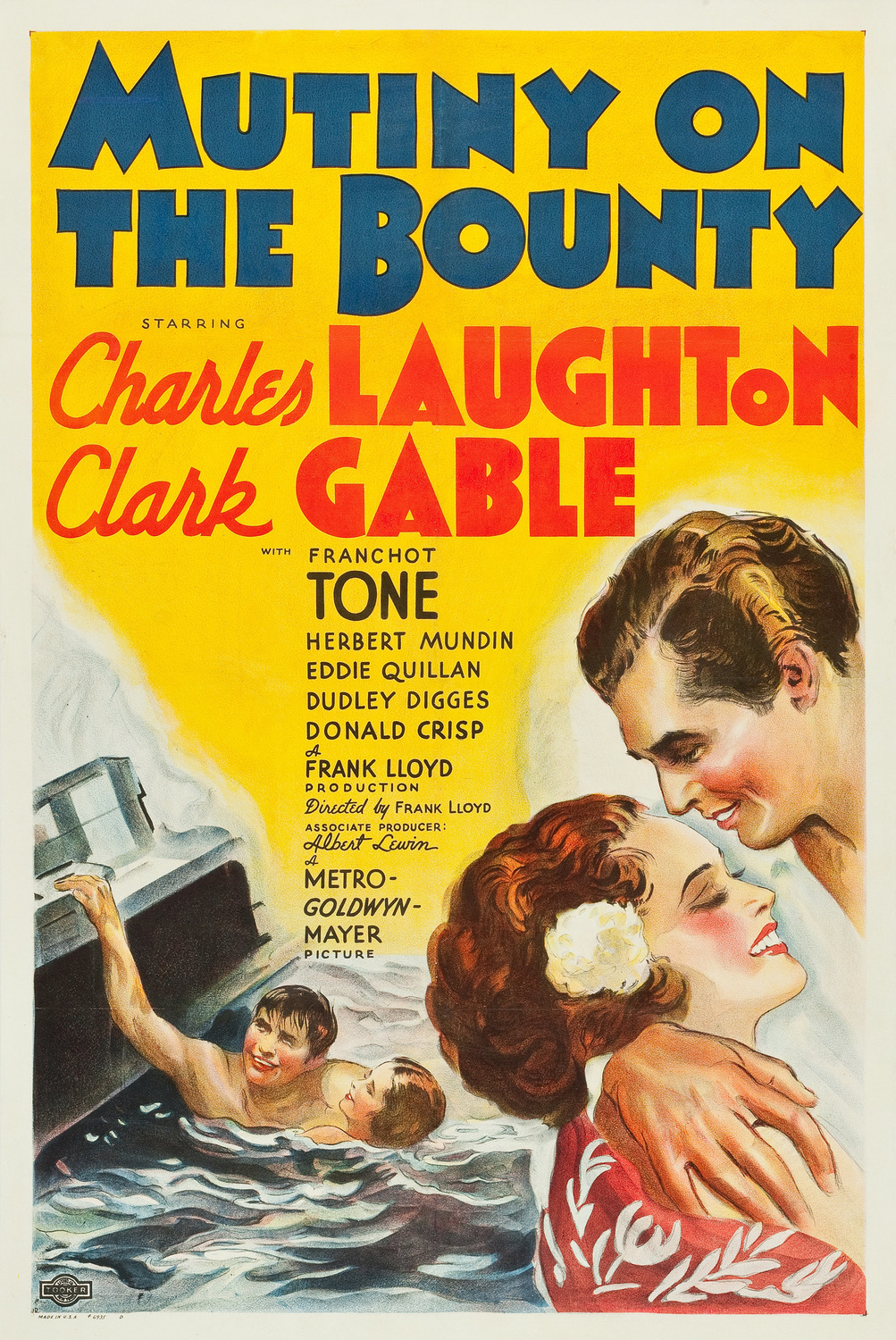
In 1935, Mutiny on the Bounty beat out Les Miserables, David Copperfield, and A Midsummer Night’s Dream for best picture. Featuring the talents of Charles Laughton, Clark Gable, Franchot Tone, Movita, and Mamo, the film was directed by Frank Lloyd and based off the Charles Nordhoff and James Norman Hall novel based off the historical event. Laughton, Gable and Tone were also nominated for Best Actor and this film is responsible for the creation of Best Supporting Actor.

The film starts as the HMS Bounty leaves England for a two-year voyage over the Pacific Ocean. The captain, William Bligh (Laughton) is a brutal tyrant who loves administering harsh punishment to his officers and crew. Fletcher Christian (Gable) is the ships lieutenant and disapproves of Bligh’s captaincy. At the same time, midshipman Roger Byam (Tone) is divided between his loyalty to his family’s naval tradition and friendship with Christian.
During the voyage, Christian and Bligh’s animosity towards each other grows when Christian challenges Bligh’s unjust practices. Upon arrival in Tahiti, where the crew acquires breadfruit plants to take back to England, Bligh refuses to let Christian leave the ship. Meanwhile, Byam sets up shop and lives with the island Chief, Hitihiti, and his daughter, Tehanni (Movita) while translating an English-Tahitian dictionary. Hitihiti persuades Bligh to allow Christian a day pass, but Bligh soon repeals it out of spite. He disregards the order and romances a Miamiti (Mamo), a local girl. When they leave, Christian promises her he will be back someday.
After leaving, the crew talks of mutiny after Bligh’s discipline kills the ship’s well-loved surgeon and cuts water rationing for the crew in favor of providing water for the cargo. While initially disapproving of mutiny, he changes his mind after seeing crew members in iron chains. The crew overthrows the ship and cast Bligh and those loyal to him adrift. Bligh is able to lead them back to a safe harbor.
Christian orders the Bounty return to Tahiti, but Byam, who was in his cabin during the mutiny, disapproves of the mutiny and decide he and Christian can no longer be friends. When back on Tahiti, Byam marries Tehanni and Christian marries and has a child with Miamiti. They soon reconcile their friendship. But the HMS Pandora is spotted off shore and the two decide to part ways. Byam and some of the crew remain on the island for the ship to take them back to England while Christian, the rest of the crew, Miamiti and other Tahitians board the Bounty to search for a new island refuge.
On the Pandora, Byam finds out that Bligh is the captain and suspects him in the mutiny. He therefore has Byam imprisoned. Upon return to England, Byam is court-martialed and found guilty but still speaks of Bligh’s tyrannical captaincy aboard the bounty. Byam’s friends Sir Joseph Backs and Lord Hood intervene for him, leading to a pardon by King George III.
As for Christian, he finds Pitcairn, an uninhabited, sustainable island that he sees as adequate refuge from the Royal Navy. He orders the Bounty be crashed and burned while those on the ship settle on the island.

A film based off a book based off of true events. As the synopsis says, the entire first half of the film sets up the titular mutiny and it does a decent job it of it. Bligh’s punishments are incredibly disproportionate to the infractions, giving you a great reason to hate him. Christian and Byam are also relatable characters, the former who constantly tries to be the level headed voice of reason and the latter who is conflicted in loyalties.
With locations of the film including French Polynesia and Catalina, the visuals are really good. They also used the Sailing Ship Restaurant in San Francisco. The music was good too, having traditional soundtrack music as well as sea shanties.

However, the film is a good example of Hollywood’s penchant of over-dramatization. As stated above, the film is pretty inaccurate. In real life, Bligh wasn’t the monster he’s made out to be. Pitcairn was also a catastrophic failure as self-government. But despite the inaccuracies, the film is pretty good.

I’m not sure why this got best picture. Probably for its depiction of a crew overthrowing a tyrant and setting up their own government.

Final Call: Historically inaccurate, but still has a good plot with great acting and impressive visuals. It’s replacing All Quiet on the Western Front as my #3.


Monday, February 17, 2014

It Happened One Night

1934 was a historic year for the 7th Academy Awards. Frank Capra’s It Happened One Night became the first of three films to win Best Picture, Best Actor (Clark Gable), Best Director, and Best Actress (Claudette Colbert) simultaneously. The other two were One Flew Over the Cuckoo’s News in 1975 and Silence of the Lambs in 1991. Shirley Temple also won the first Juvenile Award at the age of six and became the youngest actor to ever win an Oscar. The film centering on a runaway heiress, is also the first Romantic Comedy to win best Picture.

The film begins as Ellie Andres (Colbert), spoiled heiress and daughter of the wealthy Alexander Andrews (Walter Connolly), marries King Westley (Jameson Thomas). Mr. Andrews being completely against the marriage, demands an annulment. In response, Ellie runs away boarding a bus to New York City to reunite with Westley. Here, she meets Peter Warne (Gable), a recently fired newspaper reporter, who recognizes her and gives her a choice to either give him an exclusive on her story, where he will help her reunite with Westley, or he will tell her father where she is and collect the reward offered for her turn. Ellie takes the first choice.

At one of the bus stops, Ellie’s bag is stolen, leaving her to rely completely on Peter. This sets a chain reaction of adventures where Ellie loses her disdain for Peter and starts to fall in love with him. at one point, they have to hitchhike. Peter, claiming to be an expert on the subject, fails. Ellie then stops a car by lifting up her skirt and showing some leg. (The first instance of this trope actually).

At a stop, the driver, (Alan Hale) tries to leave with their luggage, prompting Peter to chase him down and take his car. One night, near the end of the film, Ellie confesses her love to peter, who mulls it over and decides he loves her too. After she falls asleep, he then leaves to make arrangements. However, the owners of the motel they are in notice the car is gone and kick Ellie out of bed, leaving her to think that Peter has deserted her.

Ellie then calls her father who agrees to let her marry Westley. However, after Peter obtains money from his old editor to marry Ellie, they pass each other on the road. Ellie, believing Peter betrayed her for the reward money, agrees to a second, formal wedding with Wesltey.

Ellie tries to pretend that nothing has happened, but she is unable to fool her father. On her wedding day, she finally reveals the whole story from her perspective. When Peter comes to Ellie’s home, Mr. Andrews offers him the reward money, but Peter insists on being paid only his expenses: 39.60. When Ellie’s father presses him for an explanation of his odd behavior, Peter admits he loves Ellie, though he believes he is crazy for doing so. Westley arrives for the wedding in an autogiro.

At the wedding ceremony, Mr. Andrews walks his daughter down the aisle, revealing Peter’s refusal of the reward money to Ellie and quietly encourages her to run off again, telling her that her car is out back for a quick get-away. At the point where she is to say “I do,” she makes up er mind and runs off to find Peter. Her pleased father pays Westley off, enabling Elli to marry Peter.

It’s a standard romantic comedy plot. “The young bride/fiancĂ©e gets stuck with a guy and neither can stand each other at first, but in time, they both end up in love.” It’s been seen so many times in film and television, probably even as early as 1935. Yet, so few are able to pull it off. It Happened One Night is one of those films where it worked, mainly due to the chemistry of Gable and Colbert. Ellie and Peter are at each others’ throats for much of the film and the way the pair acts makes the character development seem real. The outcome of the film is predictable, yes, but when the characters have a dynamic that actually makes you care about them and their story, the final destination isn’t as important as the ride there.


The comedic aspects of the films are done very well too, mixing sophisticated wit with visual humor and unrefined levity, including one running gag that meets its end in a very bawdy (for the time) manner.


The visuals aren’t all that impressive, but they really don’t have to be, considering the movie is simply following two people going from point A to point B. On the other hand, Westley landing for the wedding in the precursor to a helicopter did look good.  There’s also not a lot of music in the film, save for the beginning credits and a twice where the characters joyfully sing to pass the time. But this works as well. It didn’t feel like it needed music and the parts where there was singing (the crowd singing on a bus and Gable singing in the car), it felt in place.


The only complaint I really have is in the pacing. There were a couple spots where it was off, but it quickly corrected itself.


I honestly have no idea why this won best picture, seeing as how Cecile B. DeMille’s Cleopatra was also nominated. But I’m not questioning it.


Final Call: It Happened One Night is a great and enjoyable film, replacing Grand Hotel as #1

Friday, September 13, 2013

Cavalcade (1933)


http://upload.wikimedia.org/wikipedia/en/3/3f/Cavalcade_film_poster.jpgIt’s 1934 and the 6th Academy Awards. The most nominations for the year went to Cavalcade, A Farewell to Arms, and Lady for a Day, with four each. However, Cavalcade went away away with the most awards: Best Picture, Best Director, and Best Art Direction. 

I couldn’t find this one either, which is unfortunate because I was really looking forward to it. So, I’ll do the same thing I did with Broadway Melody.

The film itself goes from 1899 to 1933 and follows a well-to-do English family. The lives of Jane and Robert Marryot and their lives in London are on display as the film goes through various historical events, such as the Second Boer War, Titanic and World War I.

Here’s reelviews.com’s review of the film.