Showing posts with label 1935. Show all posts

Friday, February 21, 2014

Mutiny on the Bounty

In 1935, Mutiny on the Bounty beat out Les Miserables, David Copperfield, and A Midsummer Night’s Dream for best picture. Featuring the talents of Charles Laughton, Clark Gable, Franchot Tone, Movita, and Mamo, the film was directed by Frank Lloyd and based off the Charles Nordhoff and James Norman Hall novel based off the historical event. Laughton, Gable and Tone were also nominated for Best Actor and this film is responsible for the creation of Best Supporting Actor.
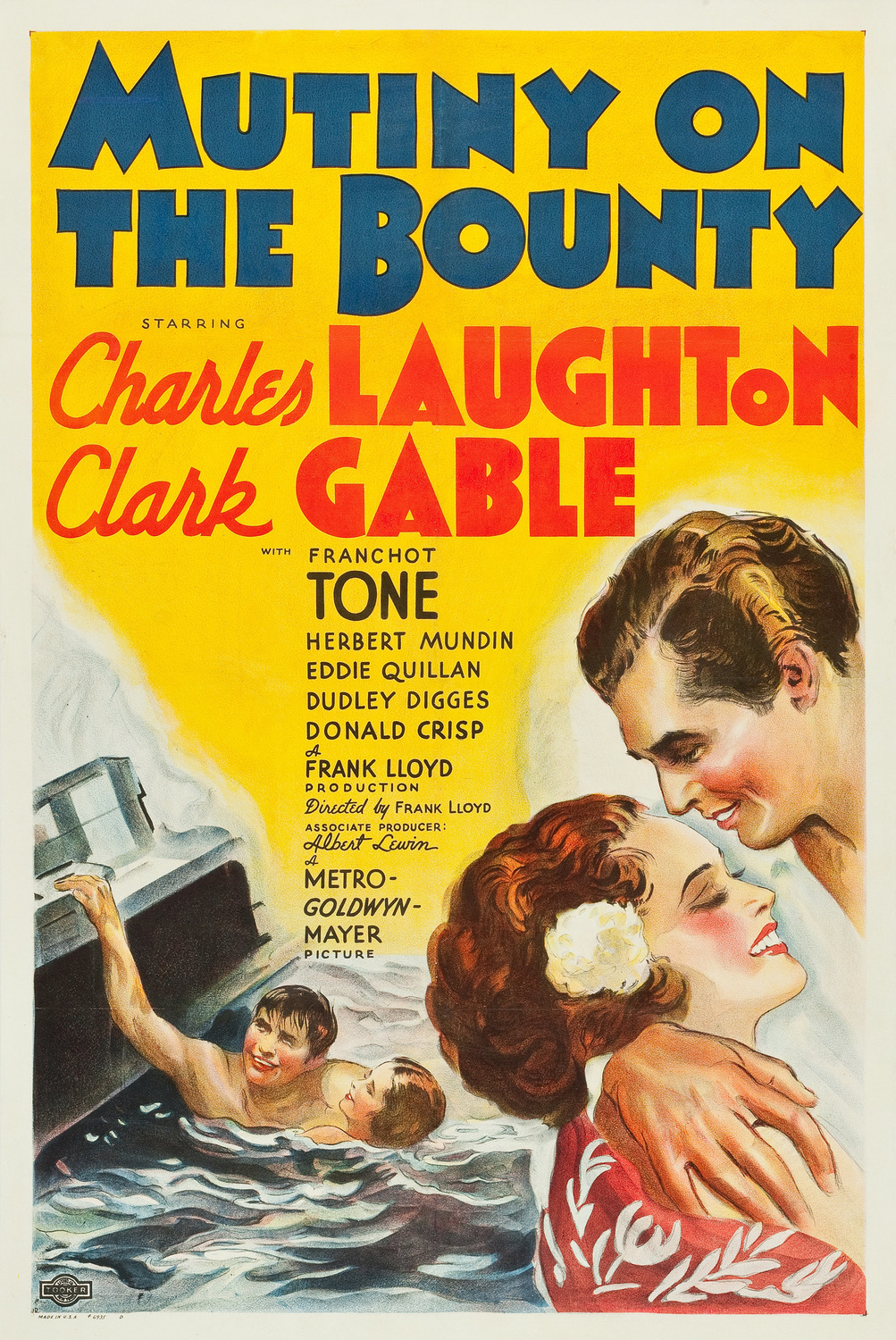
The film starts as the HMS Bounty leaves England for a two-year voyage over the Pacific Ocean. The captain, William Bligh (Laughton) is a brutal tyrant who loves administering harsh punishment to his officers and crew. Fletcher Christian (Gable) is the ships lieutenant and disapproves of Bligh’s captaincy. At the same time, midshipman Roger Byam (Tone) is divided between his loyalty to his family’s naval tradition and friendship with Christian.
During the voyage, Christian and Bligh’s animosity towards each other grows when Christian challenges Bligh’s unjust practices. Upon arrival in Tahiti, where the crew acquires breadfruit plants to take back to England, Bligh refuses to let Christian leave the ship. Meanwhile, Byam sets up shop and lives with the island Chief, Hitihiti, and his daughter, Tehanni (Movita) while translating an English-Tahitian dictionary. Hitihiti persuades Bligh to allow Christian a day pass, but Bligh soon repeals it out of spite. He disregards the order and romances a Miamiti (Mamo), a local girl. When they leave, Christian promises her he will be back someday.
After leaving, the crew talks of mutiny after Bligh’s discipline kills the ship’s well-loved surgeon and cuts water rationing for the crew in favor of providing water for the cargo. While initially disapproving of mutiny, he changes his mind after seeing crew members in iron chains. The crew overthrows the ship and cast Bligh and those loyal to him adrift. Bligh is able to lead them back to a safe harbor.
Christian orders the Bounty return to Tahiti, but Byam, who was in his cabin during the mutiny, disapproves of the mutiny and decide he and Christian can no longer be friends. When back on Tahiti, Byam marries Tehanni and Christian marries and has a child with Miamiti. They soon reconcile their friendship. But the HMS Pandora is spotted off shore and the two decide to part ways. Byam and some of the crew remain on the island for the ship to take them back to England while Christian, the rest of the crew, Miamiti and other Tahitians board the Bounty to search for a new island refuge.
On the Pandora, Byam finds out that Bligh is the captain and suspects him in the mutiny. He therefore has Byam imprisoned. Upon return to England, Byam is court-martialed and found guilty but still speaks of Bligh’s tyrannical captaincy aboard the bounty. Byam’s friends Sir Joseph Backs and Lord Hood intervene for him, leading to a pardon by King George III.
As for Christian, he finds Pitcairn, an uninhabited, sustainable island that he sees as adequate refuge from the Royal Navy. He orders the Bounty be crashed and burned while those on the ship settle on the island.

A film based off a book based off of true events. As the synopsis says, the entire first half of the film sets up the titular mutiny and it does a decent job it of it. Bligh’s punishments are incredibly disproportionate to the infractions, giving you a great reason to hate him. Christian and Byam are also relatable characters, the former who constantly tries to be the level headed voice of reason and the latter who is conflicted in loyalties.
With locations of the film including French Polynesia and Catalina, the visuals are really good. They also used the Sailing Ship Restaurant in San Francisco. The music was good too, having traditional soundtrack music as well as sea shanties.

However, the film is a good example of Hollywood’s penchant of over-dramatization. As stated above, the film is pretty inaccurate. In real life, Bligh wasn’t the monster he’s made out to be. Pitcairn was also a catastrophic failure as self-government. But despite the inaccuracies, the film is pretty good.

I’m not sure why this got best picture. Probably for its depiction of a crew overthrowing a tyrant and setting up their own government.

Final Call: Historically inaccurate, but still has a good plot with great acting and impressive visuals. It’s replacing All Quiet on the Western Front as my #3.


Monday, February 17, 2014

It Happened One Night

1934 was a historic year for the 7th Academy Awards. Frank Capra’s It Happened One Night became the first of three films to win Best Picture, Best Actor (Clark Gable), Best Director, and Best Actress (Claudette Colbert) simultaneously. The other two were One Flew Over the Cuckoo’s News in 1975 and Silence of the Lambs in 1991. Shirley Temple also won the first Juvenile Award at the age of six and became the youngest actor to ever win an Oscar. The film centering on a runaway heiress, is also the first Romantic Comedy to win best Picture.

The film begins as Ellie Andres (Colbert), spoiled heiress and daughter of the wealthy Alexander Andrews (Walter Connolly), marries King Westley (Jameson Thomas). Mr. Andrews being completely against the marriage, demands an annulment. In response, Ellie runs away boarding a bus to New York City to reunite with Westley. Here, she meets Peter Warne (Gable), a recently fired newspaper reporter, who recognizes her and gives her a choice to either give him an exclusive on her story, where he will help her reunite with Westley, or he will tell her father where she is and collect the reward offered for her turn. Ellie takes the first choice.

At one of the bus stops, Ellie’s bag is stolen, leaving her to rely completely on Peter. This sets a chain reaction of adventures where Ellie loses her disdain for Peter and starts to fall in love with him. at one point, they have to hitchhike. Peter, claiming to be an expert on the subject, fails. Ellie then stops a car by lifting up her skirt and showing some leg. (The first instance of this trope actually).

At a stop, the driver, (Alan Hale) tries to leave with their luggage, prompting Peter to chase him down and take his car. One night, near the end of the film, Ellie confesses her love to peter, who mulls it over and decides he loves her too. After she falls asleep, he then leaves to make arrangements. However, the owners of the motel they are in notice the car is gone and kick Ellie out of bed, leaving her to think that Peter has deserted her.

Ellie then calls her father who agrees to let her marry Westley. However, after Peter obtains money from his old editor to marry Ellie, they pass each other on the road. Ellie, believing Peter betrayed her for the reward money, agrees to a second, formal wedding with Wesltey.

Ellie tries to pretend that nothing has happened, but she is unable to fool her father. On her wedding day, she finally reveals the whole story from her perspective. When Peter comes to Ellie’s home, Mr. Andrews offers him the reward money, but Peter insists on being paid only his expenses: 39.60. When Ellie’s father presses him for an explanation of his odd behavior, Peter admits he loves Ellie, though he believes he is crazy for doing so. Westley arrives for the wedding in an autogiro.

At the wedding ceremony, Mr. Andrews walks his daughter down the aisle, revealing Peter’s refusal of the reward money to Ellie and quietly encourages her to run off again, telling her that her car is out back for a quick get-away. At the point where she is to say “I do,” she makes up er mind and runs off to find Peter. Her pleased father pays Westley off, enabling Elli to marry Peter.

It’s a standard romantic comedy plot. “The young bride/fiancĂ©e gets stuck with a guy and neither can stand each other at first, but in time, they both end up in love.” It’s been seen so many times in film and television, probably even as early as 1935. Yet, so few are able to pull it off. It Happened One Night is one of those films where it worked, mainly due to the chemistry of Gable and Colbert. Ellie and Peter are at each others’ throats for much of the film and the way the pair acts makes the character development seem real. The outcome of the film is predictable, yes, but when the characters have a dynamic that actually makes you care about them and their story, the final destination isn’t as important as the ride there.


The comedic aspects of the films are done very well too, mixing sophisticated wit with visual humor and unrefined levity, including one running gag that meets its end in a very bawdy (for the time) manner.


The visuals aren’t all that impressive, but they really don’t have to be, considering the movie is simply following two people going from point A to point B. On the other hand, Westley landing for the wedding in the precursor to a helicopter did look good.  There’s also not a lot of music in the film, save for the beginning credits and a twice where the characters joyfully sing to pass the time. But this works as well. It didn’t feel like it needed music and the parts where there was singing (the crowd singing on a bus and Gable singing in the car), it felt in place.


The only complaint I really have is in the pacing. There were a couple spots where it was off, but it quickly corrected itself.


I honestly have no idea why this won best picture, seeing as how Cecile B. DeMille’s Cleopatra was also nominated. But I’m not questioning it.


Final Call: It Happened One Night is a great and enjoyable film, replacing Grand Hotel as #1