In the early 1940s, the US Dept. of State commissioned a Disney goodwill tour to South America as part of the Good Neighbor Policy to counter the Latin American governments’ ties with Nazi Germany. Disney made the trip into a hybrid film, with documentary-esque shots of South America and four different segments. The resulting film, Saludos Amigos, was released in 1942.
The film has clips of the Disney artists roaming the country and drawing cartoons of the local culture and scenery.In the first animated segment, Lake Titicaca Donald Duck is an American tourist visiting Lake Titicaca and meeting some of the locals, including an obstinate llama.In the second animated short, Pedro, the title character, a small airplane from an airport near Santiago engages in his first flight to pick up air male from Mendoza. On his way back, near Aconcagua, he chases a vulture and gets caught in a terrible storm. He makes it back to the airfield with the mail. It’s just a postcard. This segment was later released as an independent short.Third, El Gaucho Goofy features Cowboy Goofy taken mysteriously to the Argentine pampas to learn the way of the native goucho.Finally, Aquarela Do Brasil involves a new character, Jose Carioca showing Donald Duck around South America and introducing him to the samba.Why did this need to be a film? The shorts are good, but would have been fine individually and there wasn’t any real need to film the goodwill tour.Final Call: This didn’t need to be a film. It drops like a stone across the Edge of Dissatisfaction and become #6, right above Victory Through Air Power.
Showing posts with label 1942. Show all posts
Showing posts with label 1942. Show all posts
Thursday, April 10, 2014
Saludos Amigos


Bambi
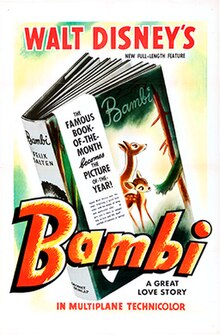 When Disney decided to make a coming of age story, he wound
up with the 1942 film Bambi, based on
the book Bambi, I Life in the Woods.
Featuring a deer growing up in the forest and befriending a rabbit and skunk, Bambi won the Academy Award for Best
Sound, Best Song and Original Music Score.
The film begins as a doe gives birth to a fawn, who she
names Bambi. His father is the Great Prince of the Forest who guards the
woodland creatures from the dangers of man. Bambi is quickly befriended by an
energetic rabbit named Thumper, a sunk named Flower and a female fawn named
Faline. As Bambi asks about the world around him, he grows attached to his
mother who cautions him about the dangers of life in the forest.
During Bambi’s first winter, his mother is shot and killed
by a hunter while helping him find food. The Great Prince leads Bambi home.
Many years later, Bambi has matured into a young stag and his childhood friends
have entered adulthood as well. They are warned of Twitterpation by Friend Owl
and that they will eventually fall in love. They treat the concept of romance
with scorn, but Thumper and Flower both encounter romantic counterparts and
change their minds. Bambi also encounters Faline and begin courtship, which is
interrupted by an older stag named Ronno, who attempts to force Faline away
from Bambi. Bambi successfully manages to defeat Ronno in battle.
Bambi is soon awaked by the smell of smoke and is warned of
a wildfire by his father. The two flee to safety, but Bambi is separated from
Faline. He searches for her and finds her cornered by hunting dogs. He wards
them off and makes it to his father with Faline on a riverbank. The following spring,
Faline gives birth to twins under Bambi’s eye as the new Great Prince of the
Forest.
Bambi is a great
film in many aspects. The animation can be drab or colorful depending on the
scene, which works with the film taking place in a forest that changes with the
seasons. There’s also not a lot of dialogue in the film, but the film does well
in conveying emotion and story without it. Also, not having man appear in the
film at all gives it greater tension. The music is also the film’s strongest
point, which might be why it won those awards. “Little April Showers,” which
plays when Bambi witnesses his first rainstorm is one of the best scenes. And
where Dumbo failed in pacing, Bambi excels. Making it shorter would
have ruined it and making it longer would have been unnecessary.
The only negative aspect was that Thumper could sometimes
get annoying. But that didn’t happen often.
Final Call: Great film with great storytelling and music. Some
minor annoyances, but that doesn’t do any disservice. It easily surpasses the
Edge of Satisfaction and stops at #2.
Wednesday, March 5, 2014
Casablanca
 Based on the unproduced stage play, Everybody Comes to Ricks, Michael Curtiz’ 1942 film Casablanca was nominated for eight
awards, winning Best Picture, Best Director and Best Screenplay. Starring
Humphrey Bogart, Ingrid Bergman, and Paul Henried, the film features a man who
must choose between love and virtue.
The film begins in December 1941, where American expatriate,
Rick Blaine (Bogart) is the proprietor of Rick’s Café Americain, a nightclub
and gambling den in the Moroccan city of Casablanca. The café attracts a variety of people: Vichy Frency,
Itallian, and German officials alongside refugees who are desperate to reach
the United States. Rick professes to be neutral in all matters, but ran guns to
Ethiopia during the war with Italy and fought against the Nationalists during
the Spanish Civil War.
The petty criminal Ugarte (Peter Lorre) shows up one day and
shows Rick letters of transit he gained by murdering two German couriers. The
papers allow the bearer to freely travel around German-controlled Europe and to
Portugal. He plans to sell them at the club later that night but is arrested by
Capt. Louis Renault (Claude Rains), a corrupt official. He dies in custody
without revealing he entrusted the letters to Rick.
Soon, Rick’s former lover and the source of his bitterness,
Ilsa Lund walks into the bar and sees Rick’s friend and house pianist, Sam. She
asks him to play “As Time Goes By.” Rick is furious that Sam disobeyed his
order to never perform that song but is stunned to see Ilsa. Her husband,
Victor Laszlo (Henried) the Czech Resistance leader, is with her as well. They
need the letters Rick has to escape to America where he can continue his work.
German Major Strasser (Conrad Veidt) has come to Casablanca to prevent it.
Laszlo makes inquiries and Ferrari (Sydney Greenstreet),
Rick’s business rival and black market figure, believes that Rick has the
letters. But he refuses to sell at any price, telling Laszlo to ask his wife
the reason. They are interrupted when Strasser leads a group of officers in
singing “Die Wacht am Rhein,” a German patriotic anthem. Laszlo orders the
house band to play “La Marseillaise” and starts singing along. He is alone at
first, but the crowd soon joins in and drowns out the Germans. Strasser has
Renault close the club under any means necessary. He chooses gambling.
That night Ilsa confronts Rick in the café. He refuses to
give her the letters and she threatens him with a gun, but confesses she still
loves him. She explains that when they first met and fell in love in Paris in
1940, she believed Laszlo had been killed in attempting to escape a
concentration camp. However, when she was preparing to flee with Rick from the
fall of Paris to the German army, she learned he was alive and in hiding and
left Rick without explanation.
Rick’s cynicism and bitterness dissolve and he agrees to
help her. Laszlo shows up unexpectedly having escaped a police raid on a
Resistance meeting. Rick has his waiter take Ilsa away and Laszlo, now aware
that Ilsa loves Rick, tries to persuade him to use the letters to take her to
safety. The police turn up to arrest Laszlo on a minor, exaggerated charge, but
rick convinces Renault to release him by promising a set up for the more
serious crime of possession of letters of transit. When trying to arrest Laszlo
as arranged at the airport, Rick holds Renault at gunpoint to assist in their
escape. But at the last moment, he makes Ilsa board the plane to Lisbon with
Laszlo, explaining that she would regret it if she stayed.
Strasser drives up alone and is killed by Rick when he tries
to intervene. The police arrive, but Renault tells them to round up the usual
suspects. The film ends as Renault suggests to Rick they join the Free French
and walk away into the fog with Rick saying that it was the beginning of a
beautiful friendship.
Rick’s character development is a big part in making this
film what it is. Rick is introduced as a stubborn cynic who really wants no
part in anybody’s affairs but his own. But when his past comes back in the form
of Ilsa, he’s faced with the reality of why it all happened. He releases his
grudge and does everything he can to get Ilsa and Laszlo out of Casablanca. It’s
true and realistic development too, as he doesn't turn into a complete idealist
as the film ends, but is slowly developing into a better person.
The music is done exceptionally well too. Written by Max
Steiner, who also wrote the score to Gone
with the Wind, he based the entire score on “As Time Goes By” and “La
Marseillaise” and had the latter and the opening bars of “Deutschlandlied” as leitmotifs.
This gave greater depth to the setting and characters. Also, the duel of songs
between Strasser and Laszlo is one of the best parts in the film and sets up
arguably the funniest line.
It should also be noted that the script was continually
going through re-writes, even during filming. The screenwriters essentially made
the film up as they went along. Yet it was still cleverly written and continues
to be one of the most quoted films. However, at no time is Sam told “Play it
again, Sam.” Blame Woody Allen for that.
Why did this get Best Picture: Because it involved the Czech
Resistance most likely.
Final Call: An enjoyable and unforgettable film with great
characters, music and writing. It jumps to #1.
Monday, March 3, 2014
Mrs. Miniver
 William Wyler’s 1942 film Mrs. Miniver was nominated for 12 Academy Awards, winning Best
Picture, Best Director, Best Actress (Greer Garson), Best Screenplay, Best
Supporting Actress (Teresa Wright), and Best B&W Cinematography. With
Garson alongside Walter Pidgeon, the film centers around A British housewife in
rural England during the early months of World War II.
Mrs. Kay Miniver (Garson) and her family live at a house
called Starlings in Belham just outside London. The house has a large garden
that overlooks the River Thames. Mr. Clem Miniver (Pidgeon), a successful architect
owns a motorboat. The two have three children: Toby, Judy and Vin (Christopher
Severn, Clare Sandars, and Richard Ney) and a staff of Gladys the Housemaid
(Brenda Forbes) and Ada the cook (Marie De Becker).
On the eve of World War II, Vin comes home from university
and meets Carol Beldon (Wright), the grandaugther of Lady Beldon (Dame May
Whitty). Despite disagreements, especially in Vin’s idealistic attitude to
class differences, the two fall in love. Vin proposes to Carol but when the war
comes clower to home, feels he must do his part and enlists in the Royal Air
Force. He qualifies as a fighter pilot and is posted to a base near his parents’
home and is able to signal safe return from operations by cutting his engines
briefly as he flies over the house. Clem also volunteers to take his motorboat
to assist in the Dunkirk evacuation.
One morning, while Clem is still away, Kay is unable to
sleep and wanders down to the private dock. She discovers a wounded German
pilot (Helmut Dantine) hiding in her garden. He holds her at gunpoint and
demands food and a coat while asserting that the Third Reich will mercilessly
overcome its enemies. She feeds him, disarms him and calls the police. Soon
after, Clem returns home.
Lady Beldon visits Kay to convince her to talk Vin out of
marrying Carol due to her youth. She is unsuccessful when Kay reminds her that
she was married young. Soon, Vin and Carol are married, and honeymoon in
Scotland. Later, Kay and her family take refuge in their garden bomb shelter
and keep their minds off the bombing while reading Alice’s Adventures in Wonderland. Clem calls it a lovely story as
they barely survive a bomb landing and destroying parts of the house.
At the village flower show, Lady Beldon disregards the judges’
decision that her rose of the winner and announces that the local stationmaster,
Mr. Ballard (Henry Travers) is the winner of the Mrs. Miniver rose, with her
own taking second place. Air raid sirens sound and the villagers take refuge in
the cellars of Beldon Hall. Kay and Carol drive Vin to join his squadron. On
the way home, they witness a dogfight. For safety, Kay stops the car and they
see a German plane crash. Carol is wounded from the plane’s fire and Kay takes
her back to Starlings, where she dies in minutes. Kay is devastated and Vin is
told when he returns from battle.
The film ends as the villagers assemble at the badly damaged
church where the vicar (Henry Wilcoxon) delivers a sermon affirming their
determination. Lady Beldon stands in her family’s church pew and Vin moves to
stand alongside her. The congregation sings Onward, Christian Soldiers while
RAF fighters are seen though the bombed church roof flying to face the enemy.
Where All Quiet on the
Western Front exposes the harsh realities of war in the eyes of the
fighting men, Mrs. Miniver shows it from
the perspective of the civilians and families. The film gives an honest look at
that perspective. There are painful moments and the characters are indeed
afraid, but they exhibit outward bravery and strength for the well-being of
their community.
The aforementioned would not have been possible had not the
acting been so great. Garson and Wright put on amazing performances with simply
their eyes. With Kay and Carol showing their outward bravery, their eyes truly
showed that inside, they were unsure and frightened of what would lay ahead.
Those two deserved the Oscars they received.
Sure, this is one in a series of WWII propaganda films. But
apart from the end, it doesn't feel like it.
This most definitely won Best Picture due to its portrayal
of a small community during the early war.
Final Call: An honest look at the home front’s perspective
of the war with acting that drives it home. I suppose it’s impossible to rank a film like
this for enjoyment. It prompts the creation of an “Exceptions” list. And the more
I think about it, All Quiet on the
Western Front belongs there too.
Subscribe to:
Posts (Atom)