Showing posts with label JIminy Cricket. Show all posts

Tuesday, April 15, 2014

Fun and Fancy Free

File:Funfanposter.jpgSeptember 27, 1947 saw the release of the fourth package film by Disney. Fun and Fancy Free featured two shorts framed by Jiminy Cricket. Starring Cliff Edwards, Edgar Bergen, Luana Patten, Walt Disney, Clarence Nash, Pinto Colvig, Billy Gilbert, Anita Gordon, Dinah Shore, Sterling Holloway and Dennis Day, the film would be the last time Disney voiced Mickey Mouse, replacing himself with Jimmy MacDonald.

The film begins as Jiminy Cricket first appears inside a large plant in a house. Exploring it while singing, he comes across a doll, a teddy bear, a record player and some records. He sets it up to play the story of Bongo
The first segment, Bongo, based on Sinclair Lewis’ “Little Bear Bongo,” features a circus bear named Bongo who wants to be free in the wild. He breaks free and takes about a day before the idealism is met with harsh conditions. The next morning, he meets a female bear named Lulubelle. They fall in love, but an enormous bear named Lumpjaw cuts in. Bongo fails to interpret Lulubelle slapping him as a sign of affection and she accidentally slaps Lumpjaw, causing him to claim her for himself. He forces the bears into a celebration for them. Bongo comes to understand the meaning of slapping one another among bears and challenges Lumpjaw. Bongo is able to outwit Lumpjaw, but the two go over a waterfall. Lumpjaw is swept away and Bongo is able to claim Lulubelle.
Between Bongo and the second short, Jiminy finds a birthday party going on where Edgar Bergen is entertaining Luana Patten and… living ventriloquist dummies.  Bergen sets up the second short, Mickey and the Beanstalk.
An adaptation of Jack and the Beanstalk, Mickey, Donald, and Goofy are peasants living in a place called Happy Valley, which was plagued by drought after a golden harp was stolen from a nearby castle. After Donald tries to kill their cow with an axe, Mickey trades the cow. However, when he comes back, he reveals he traded the cow for beans instead of money. Donald throws tem through a hole in the floor and a beanstalk sprouts overnight. It carries the house to a gigantic kingdom and the three enter the castle. They help themselves to the food, but Willie the Giant spots them. Willie is able to transform himself in to anything and Mickey asks him to turn into a fly when he spots a fly swatter. However, Willie turns into a pink bunny but when he spots them with the swatter, he captures them and locks them in a box. Mickey escapes to find the key and finds the golden harp. He frees the others and takes the harp to her rightful place in Happy Valley, which is returned to normal. They then kill Willie by chopping down the beanstalk.
Actually Willie survives and is looking for Mickey Mouse in Hollywood.

While I have to commend the framing of Jiminy Cricket being in the position to start up the stories, it’s not much of a frame story. It seems like Disney was trying to find a way to force these two stories together and thought the character of Jiminy was the perfect idea. In actuality, the inclusion of Jiminy makes it feel even more forced. And the living ventriloquist dummies? They don’t seem out of place, but seem downright bizarre and disturbing in context of Edgar Bergen entertaining Luana Patten at a party. I realize they wanted some sort of comic relief in the scene, but couldn’t that have been done with actual people? Especially since the dummies eventually just snarked over Bergen’s narration of the beanstalk short.
That’s not to say the shorts aren’t good. Bongo is interesting and Mickey and the Beanstalk is rather enjoyable. But they would have been better had they been released as individual shorts.


Final Call: entertaining shorts, but has an odd frame that feels forced. I did like it better than Make Mine Music though, which makes Fun and Fancy Free my new #6

Monday, March 31, 2014

Pinocchio

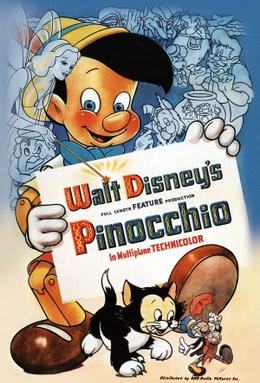
File:Pinocchio-1940-poster.jpgAfter the success of Snow White and the Seven Dwarfs, Disney decided to make another full length animated feature. In 1940, Pinocchio, based off of Carlo Collodi’s children’s novel The Adventures of Pinocchio was released. Starring Cliff Edwards, Dickie Jones, Christian Rub, Mel Blanc, Walter Catlett, Charles Judels, Evelyn Venable, and Frankie Darro, it became the first animated feature to win an Academy Award: Best Music, Original Score and Best Music, Original Song for “When You Wish upon a Star.” It was, however, a box office disaster, only making a profit in its 1945 reissue.

After singing “When You Wish upon a Star,” Jiminy Cricket explains that he is going to tell a story of a wish coming true. It begins in the Tuscany workshop of a woodworker named Geppetto. Jiminy watches the man finishes work on a wooden marionette whom he names Pinocchio. Before falling asleep, Geppetto makes a wish on a star that Pinocchio could be a real boy. During the night, the star, in the form of a Blue Fairy visits the workshop to grant Geppetto’s wish. She gives Pinocchio the breath of life, although he still remains a puppet. The fairy informs Pinocchio that if he desires to become a real boy of blood and flesh, he must prove himself to be brave, truthful, and unselfish and able to tell right from wrong by listening to his conscience. Pinocchio does not understand what a conscience is, so Jiminy appears to explain it to him. The Blue Fair asks if Jiminy would serve as Pinocchio’s conscience. He accepts.
Geppetto discovers that his wish has come true and is filled with joy. However, on his way to school, Pinocchio is led astray by Honest John the Fox and Gideon the Cat. They convince him to join Stromboli’s puppet show, despite Jiminy’s objections. Pinocchio becomes Stromboli’s star attraction as a marionette who can sing and dance with no strings while performing with Dutch girls, French can-can girls, and Russian Cossacks. However, when Pinocchio wants to go home for the night, Stromboli becomes angry, locks him in a birdcage threatens him to perform around the world and warns him that when he grows too old, he will chop him into firewood. Jiminy arrives to see Pinocchio and is unable to free him. When the Blue Fairy appears and asks Pinocchio why he disobeyed Geppetto, Pinocchio invents a story in order to hide his shame. With each lie, his nose grows even longer and the Blue Fairy explains that a lie will keep growing and growing until it’s as plain as the nose on his face. Pinocchio vows to be good from now on and the Blue Fairy restores his nose back to its original form and sets him free, warning that this will be the last time she helps him as Pinocchio and Jiminy escape.
Meanwhile, across town, Honest John and Gideon become acquainted with a coachman who promises to pay them big money if they can find him stupid boys to take to Pleasure Island. They convince Pinocchio that he is sick and the only cure is to go there as a vacation. There, he befriends Lampwick, a misbehaved disillusioned boy. With no rules or authority to stop them, Pinocchio and the other boys enjoy gambling, smoking, drunkenness, and vandalizing. Jiminy becomes angry when he discovers that Pinocchio is friends with Lampwick and storms off. Later, Jiminy discovers that the island harbors a terrible curse which the Coachman used to manipulate boys into making jackasses of themselves and becoming real donkeys. Selling them to working the salt mines and circuses. Jiminy runs back to warn Pinocchio only to find Lampwick transformed into a donkey. Pinocchio manages to escape with only a donkey’s ears and tail
Upon returning home, Pinocchio and Jiminy find the workshop empty and learn from a letter by the Blue Fairy disguised as a dove that Geppetto went to sea to look for Pinocchio. There, he was swallowed along with his cat Figaro and goldfish Cleo by the giant whale named Monstro. They are now living in his belly. Determined to rescue his father, Pinocchio jumps to the bottom of the ocean with Jiminy. He is soon swallowed by Monstro and reunited with Geppetto. Pinocchio devises a plan to excape by burning wood in order to make Monstro sneeze. The plan works, but the whale gives chase and smashes their raft. Pinocchio refuses to abandon Geppetto and pulls him to safety in a cave under a cliff before Monstro rams into it. They wash up on a beach, but Pinocchio is dead.
Back home, the group mourns for him. However, the Blue Fairy decides that Pinocchio has proven himself brave, truthful, and unselfish, and he is reborn as a real human boy. Geppetto and Pinocchio dance around the workshop to celebrate while Jiminy steps outside to thank the Fairy. He is rewarded with a solid gold badge that certifies him as an official conscience.

While Pinocchio was not originally a great financial success, the film ages fairly well. It’s a great story proving one’s worth. It may delve into dark situations and be a little heavy handed at times, but doing so works with the overall story. It shows just what Pinocchio has gotten himself into and how far he is willing to go to reverse his situation. And while the animation isn’t quite as good as Snow White, it’s still impressive.
Something must also be said about the music, since Disney has pretty much made “When You Wish upon a Star” its theme song. It’s a great song and deserved the Academy Award. It’s also the best song on the soundtrack. Most of the others aren’t bad either. The only one that seemed unnecessary was “Little Wooden Head,” in the beginning.
There’s also a few minor problems. Jiminy Cricket is supposed to be leading Pinocchio down the straight and narrow as his conscience, but he flirts with every woman he sees, including fish. It’s funny, but gets old. The Blue Fairy says she can no longer help him after rescuing him from Stromboli. Then why does she fly by and drop the letter? Did she write it or was she just a messenger. And if she was just a messenger, who wrote it and how did they know where Geppetto was? Also how does a wooden puppet without lungs drown?
By now I’m just nitpicking. Pinocchio is an excellent film.


Final Call: Pinocchio delivers a great story with mostly good songs. It surpasses the Edge of Enjoyment and becomes #2 under Snow White