Showing posts with label Pat Buttram. Show all posts

Monday, May 19, 2014

A Goofy Movie

Goof Troop was a pretty popular series, causing Disney to produce a theatrical sequel after it ended. Starring Bill Farmer, Jason Marsden, Rob Paulsen, Pauly Shore and Pat Buttram, A Goofy Movie was released April 7, 1995. It ended up being dedicated to Buttram, who died during production.
“I2I” was also one of the first songs I ever put on my iPod.

A Goofy Movie.pngGoofy (Farmer) is a single father to the teenage Max (Marsden), who gets into trouble on the last day of school. Goofy becomes worried that he hasn’t been spending enough time with Max and decides to take him on a road trip However, Max is more worried about impressing Roxanne (Kellie Martin), a girl at his school. The road trip will mean he’ll have to miss a date with her and he claims it’s because Goofy is taking him to a concert in Los Angeles, where he will appear on stage with the pop sensation, Powerline (Tevin Campbell).

Where Ducktales the Movie felt like a glorified series finale, A Goofy Movie succeeded in actually feeling like a theatrical continuation of the series. It’s set quite a bit after the series too and succeeds in aging Max and PJ well.
Max has grown into a realistic teenager, obsessed with current pop culture and embarrassed at Goofy. Sure he was embarrassed in the series, but here, he actually loathes Goofy at times. And for good reason. Goofy just won’t take the time to shut up and listen. But at the same time, he’s trying to be a good father by doing what he thinks is best for his son. And you can’t really blame him, thanks to Principal Mazur blowing Max’s stunt completely out of proportion, going from harmless interruption and musical interlude to gang fight causing a riot, Goofy thought he was actually doing Max some good. Both sides are actually to blame for the plot. Goofy won’t get Max’s side of the story and Max is too busy brooding after heading out on the open road to tell his father. It’s interesting to see how both characters develop. By the time “Nobody Else But You” is sung, they’ve come to really understand where the other is coming from. And then Goofy makes Max’s lie a reality.
The other characters are pretty flat and are the same from how they were in the series. Pete’s still a dominating father and PJ is still a neurotic twit. There are also characters who don’t appear in the series. Bobby is your stereotypical 90s surfer/stoner. But since he’s voiced by everyone’s favorite washed up 90s stereotypical surfer/stoner actor (Pauly Shore), it’s pulled off moderately well. Though, there’s not much to say for Roxanne, she barely shows up, but it’s easy to see why Max likes her. The best side character is probably Principal Mazur. Because he has no idea what students actually like or want to do and thinks that popular music is cause for believing the student is in a gang and will head for the electric chair. On the other hand, where are Peg and Pistol? There’s a popular theory that she divorced him and took Pistol between series and movie, but there needs to be an actual explanation for their absence.
Also, a lot of background characters have a tendency to freeze while there’s still action going onscreen. Seriously. In the diner, people stop eating, the cook stops cooking and the waitress just stands there. I’ve seen television shows that do it better. But it’s only in a few areas and, while distracting, doesn’t really harm the film.

#25

Sunday, May 4, 2014

The Fox and the Hound

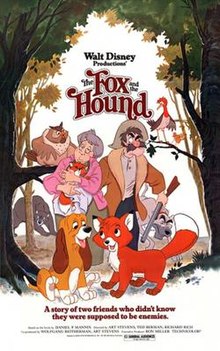
The Fox and the Hound.jpgDaniel P. Mannix’s novel The Fox and the Hound was Disney’s 1981 animated release. Starring Kurt Russell, Mickey Rooney, Pat Buttram, John Fiedler, and Pearl Bailey, it was the most expensive animated film at the time. It won the 1982 Golden Screen Awards and was nominated for the Best Fantasy Film for the Saturn Awards and Best Motion Picture – Fantasy or Comedy – Family Enjoyment for the Youth in Film Awards. The film received a midquel in 2006.

The plot features an old woman ( Jeanette Nolan) taking in an orphan fox, who she names Tod (Keith Mitchell, later Rooney). At the same time, her hunter neighbor brings home a hound dog named Copper (Corey Feldman, later Russell). He intends on raising him to be a hunting dog, however Tod and Copper become best friends. However, this raises conflict between their owners and after the two grow up, they find themselves on opposite sides after the hunter’s other dog, Chief (Buttram), is injured.
There is also a subplot about a couple of birds trying to get a caterpillar.

Those who have been following my reviews know that I can’t stand when movies are cute for the sake of being cute. This film doesn’t do that. We do get cutesy scenes, but it’s meant to portray the innocent and idyllic childhoods of Copper and Tod and work very well when juxtaposed with the latter half of the film, where Copper goes to great lengths to track down Tod to avenge Chief. You find yourself wanting the serenity and innocence of those early scenes. The ending is also done very well, with the bear attack and Copper realizing that his lust for vengeance has blinded him to what he used to value. It makes for good character development and redemption.
The subplot with the two birds is simply there for comic relief. And that’s not bad considering the overall tone of the film. People need to have something to laugh at when the heavier moments are making us all think about love, life, and friendship. It’s not overused, nor do they overstay their welcome.
Speaking of the tone, I feel it could have been heavier. Copper gets bloodlust when Chief is injured falling off train tracks. But he still lives. Copper’s call for Tod’s head and subsequent realization might have been more meaningful had that dog actually died. It could be argued that with Chief simply being hurt, it shows that Copper and the hunter are being irrational in breaking a few laws to hunt down Copper, but it makes sort of lessens Copper’s redemption. Instead of “he hurt my friend, but this fox is also my old friend and I realized what I’m doing,” it could have been, “He killed my friend, but this fox is also my friend and I forgive him.”
When the widow gives Tod up, he eventually runs into a female fox, who is his primary love interest. While I enjoy that they don’t immediately fall in love, I feel that when they do, it’s too quick, which made it feel forced. But eventually, it grew to feel more natural.
 As for the songs, “Best of Friends” is ok, but everything else isn’t very memorable.


Final call: Not as heavy as it should be, but exceeds in what it does. #3

Wednesday, April 30, 2014

Robin Hood

November 8, 1973 saw the release of Disney’s take on the English legend of Robin Hood. Starring Phil Harris, Andy Devine, Pat Buttram, and Roger Miller, the film uses anthropomorphic animals rather than people.

Robinhood 1973 poster.png
Narrated by the rooster Alan-a-Dale (Miller), Robin Hood (Brian Bedford) and Little John (Harris) rob from the rich to give to the poor of Nottingham. They are wanted by the Sheriff (Buttram) but fails every time he tries to catch them. Prince John (Peter Ustinov) and his assistant Sir Hiss (Terry-Thomas) have arrived in Nottingham after being robbed by Robin and Little John.
The Sheriff taxes Friar Tuck (Devine) and a family of rabbits, but Robin arrives to give them back some money and his hat and bow and arrow to the rabbit Skippy for his birthday. He tests it out, but fires an arrow into the castle of Maid Marian (Monica Evans). They go in and get it back, meeting Marian who reveals that she and Robin were childhood sweethearts but have not seen each other in years.
At the same time, Tuck tells Robin and Little John that Prince John is hosting an archery tournament. Robin participates while disguised as a stork and Little John as the Duke of chutney. Robin wins, but is exposed by Prince John. The two fight and eventually, Robin meets the townsfolk in the forest, where they sing the “Phony King of England,” leading the taxes to be tripled.
Friar Tuck is also arrested and Prince John plans to hang him to lure Robin. However, He and Little John sneak in and free all the prisoners. Robin steals the taxes, but is found by Hiss. During the escape, Robin is cornered by the sheriff, but sets fire to the castle and leaps intot he moat. He emerges unharmed.
King Richard (Ustinov) return and arrests his brother, the sheriff, and Hiss and allows Robin and Marian to be married.

Another one of the few times Disney decided not to go with the love at first sight formula. Because they already loved each other before the movie began! One of the finer moments of the film is during the aptly named song, “Love.” The two are rediscovering their love for each other after many years and remembering just why they fell in love. This is done very well and very believably. The song was also nominated for an Oscar, but lost to “The Way We Were.”
Robin also isn’t your flawless hero. In the beginning of the film, he’s expressing doubt about how Marian feels about him after all that time. It’s quite nicely juxtaposed with Marian having the exact same feelings, which is another reason for what makes the above sequence so great.
And there’s a lot of humor in Prince John as a villain. He’s largely ineffective and has a hair-trigger temper, but he allies himself with someone who can get stuff done. The Sherriff is sneaky and cunning in how he manages to get the money for the taxes and has no qualms about ripping off what he thinks is a blind beggar or hanging a friar. He effectively demonstrates the qualities of a sociopath who was given too much power and will take the orders of whoever pays him.
On the other hand, Hiss tries to act as Prince John’s voice of reason, but John is so into his ego as the prince that he doesn’t listen to anything he says. And when everything crashes down, Hiss takes the blame as it’s never John’s fault. But Hiss does have some sort of standard, as he thinks hanging friar tuck goes just a bit too far.
The only slight problem with the film is that it takes and traces over footage from previous films. This is largely apparent in the forest dance sequence. However, this is allotted to the film’s small budget and doesn’t harm the film in any way.


Final Call: A fun take on the legend of Robin Hood. #7.