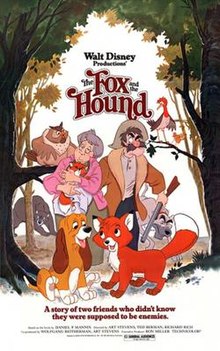
 Daniel P. Mannix’s novel The
Fox and the Hound was Disney’s 1981 animated release. Starring Kurt
Russell, Mickey Rooney, Pat Buttram, John Fiedler, and Pearl Bailey, it was the
most expensive animated film at the time. It won the 1982 Golden Screen Awards
and was nominated for the Best Fantasy Film for the Saturn Awards and Best
Motion Picture – Fantasy or Comedy – Family Enjoyment for the Youth in Film
Awards. The film received a midquel in 2006.
Daniel P. Mannix’s novel The
Fox and the Hound was Disney’s 1981 animated release. Starring Kurt
Russell, Mickey Rooney, Pat Buttram, John Fiedler, and Pearl Bailey, it was the
most expensive animated film at the time. It won the 1982 Golden Screen Awards
and was nominated for the Best Fantasy Film for the Saturn Awards and Best
Motion Picture – Fantasy or Comedy – Family Enjoyment for the Youth in Film
Awards. The film received a midquel in 2006.
The plot features an old woman ( Jeanette Nolan) taking in
an orphan fox, who she names Tod (Keith Mitchell, later Rooney). At the same
time, her hunter neighbor brings home a hound dog named Copper (Corey Feldman,
later Russell). He intends on raising him to be a hunting dog, however Tod and
Copper become best friends. However, this raises conflict between their owners
and after the two grow up, they find themselves on opposite sides after the
hunter’s other dog, Chief (Buttram), is injured.
There is also a subplot about a couple of birds trying to
get a caterpillar.
Those who have been following my reviews know that I can’t
stand when movies are cute for the sake of being cute. This film doesn’t do
that. We do get cutesy scenes, but it’s meant to portray the innocent and
idyllic childhoods of Copper and Tod and work very well when juxtaposed with
the latter half of the film, where Copper goes to great lengths to track down
Tod to avenge Chief. You find yourself wanting the serenity and innocence of
those early scenes. The ending is also done very well, with the bear attack and
Copper realizing that his lust for vengeance has blinded him to what he used to
value. It makes for good character development and redemption.
The subplot with the two birds is simply there for comic
relief. And that’s not bad considering the overall tone of the film. People
need to have something to laugh at when the heavier moments are making us all
think about love, life, and friendship. It’s not overused, nor do they overstay
their welcome.
Speaking of the tone, I feel it could have been heavier.
Copper gets bloodlust when Chief is injured falling off train tracks. But he
still lives. Copper’s call for Tod’s head and subsequent realization might have
been more meaningful had that dog actually died. It could be argued that with Chief
simply being hurt, it shows that Copper and the hunter are being irrational in
breaking a few laws to hunt down Copper, but it makes sort of lessens Copper’s
redemption. Instead of “he hurt my friend, but this fox is also my old friend
and I realized what I’m doing,” it could have been, “He killed my friend, but this
fox is also my friend and I forgive him.”
When the widow gives Tod up, he eventually runs into a
female fox, who is his primary love interest. While I enjoy that they don’t
immediately fall in love, I feel that when they do, it’s too quick, which made
it feel forced. But eventually, it grew to feel more natural.
As for the songs, “Best
of Friends” is ok, but everything else isn’t very memorable.
Final call: Not as heavy as it should be, but exceeds in
what it does. #3

