Showing posts with label 1959. Show all posts

Friday, August 15, 2014

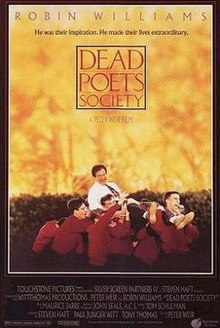
Dead Poets Society

Dead poets society.jpgBased on scriptwriter, Tom Schulman’s life at the Montgomery Bell Academy in Nashville, Dead Poets Society was released in June 1989. Starring Robin Williams, Robert Sean Leonard, Ethan Hawke, Josh Charles, Gale Hansen, Norman Lloyd and Kurtwood Smith, it grossed over $230 million and won the award for Best Original Screenplay. Williams was also nominated for Best Actor, Director Peter Weir was nominated for Best Director and the film was nominated for Best Picture, but lost to Driving Miss Daisy.

In 1959, Welton Academy hired John Keating (Williams) as the new English teacher for the upcoming school year. Inspiring his students to go against the flow and be themselves, he makes poetry cool and rebellious. A group of his students (Leonard, Hawke, Charles, Hansen, James Waterston and Allelon Ruggiero) also form a group called the Dead Poets Society, sneaking out at night to read poetry in a secluded cave.

I’ll never forget the first time I saw this film, in the middle of my sophomore year high school English class at the beginning of a unit on poetry. I enjoyed it back then and I always watch at least some of it when I come across it on TV. Dead Poets Society is one of Williams’ best acted films with him alongside a great cast, incredible writing and good cinematography.
Ebert said Williams spoiled the film by occasionally veering into his comedic persona. He failed to understand the character. While Keating did have his comedic moments, they diverted from his mostly serious and instructive persona. In other words, Williams made him into a normal person who liked to insert a little humor into a serious lesson. Furthermore, the moments where he’s seriously teaching completely overshadow those comedic moments, especially during the whole improvised poetry scene with one of his students calling Walt Whitman a “sweaty-toothed madman.”
The above scene might also be one of the best scenes in the entire film in regards to the writing and cinematography as well. The lines from the improvised poem and the spinning camera do really well in cementing the scene as a lesson Keating gives the student in really seizing the moment and living out his first lesson of carpe diem. The final shot is also perfect, with the students standing in solidarity on their desks. It shows that Keating’s lesson of seeing the world differently, being themselves and going against the flow did get through to them and that they will act it out.
That brings forth the message of the film, which, yes, it’s blatant and whacks the viewer upside the head. But it’s one of those films that’s so well made, the viewer doesn’t care they were just assaulted with a heavy idea.

Dead Poets Society is a great film and definitely one of Williams’ best. 

Wednesday, April 23, 2014

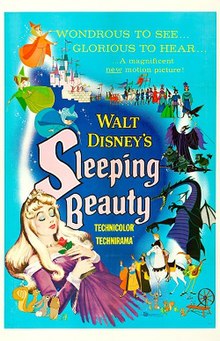
Sleeping Beauty

Sleeping beauty disney.jpg
In 1959, the Walt Disney Company produced its last fairy tale adaptation for 30 years. Based on the stories La Belle au bois dormant by Charles Perrault and Little Briar Rose by The Brothers Grimm, Sleeping Beauty was released on January 29, 1959. The film’s score was based on arrangements and adaptations from the Tchaikovsky ballet. It was also the first animated film to use the Super Technirama 70 widescreen process. This wouldn’t happen again for 54 years.

When King Stefan (Taylor Holmes) and Queen Leah (Verna Felton) welcome the birth of their daughter, Princess Aurora, the kingdom’s subjects gather to pay her homage. She is also betrothed to Prince Phillip (Bill Shirley), the son of King Hubert (Bill Thompson). The good fairies Flora (Felton), Fauna (Barbara Jo Allen), and Merryweather (Barbara Luddy) bless the child with the gifts of beauty and song, but the evil fairy Maleficent (Eleanor Audley) appears to curse the infant to death by pricking her finger on a spinning wheel before her sixteenth birthday is over. Merryweather weakens the curse, changing it into a deep sleep, only revered by true love’s kiss.
King Stefan orders all the spinning wheels to be burnt and the three fairies take Aurora into the forest until her sixteenth birthday passes.
The years pass and on her sixteenth birthday, Aurora meets Prince Phillip while out in the forest and fall in love without knowing who each other are. She rushes home and finds out she is the princess. But Maleficent’s raven has found them.
Aurora is taken back to the palace, but is lured into a secret passageway to fulfill the prophecy. The fairies place a charm to make everyone else fall asleep as well until the spell is broken. They overhear that Prince Phillip met Aurora in the forest and went back to see her, but was taken by Maleficent.
The fairies realize this, free him and help him get to Aurora. Maleficent transforms into a dragon, but Philip kills her, and enters the palace to awaken Aurora. He does so and the two live happily ever after.

Production for Sleeping Beauty began in 1951, with most of the work being centered on the art and music. This is quite evident as those two aspects are the best part of the film. The art is fantastic, with the backgrounds drawn to evoke a renaissance feel. This is quite different from most Disney films at the time, but this works rather well, considering the time period the film is set in. It makes it more authentic. The musical adaptations of Tchaikovsky’s ballet are also very well done.
The story is a bit different than the original fairy tale. One aspect of the original tale includes the prince’s mother being an ogress who means to eat their children and eventually cooks herself. This would have made an interesting movie, but would have been a terrible choice for Disney. The directors and Disney made the right choices of what to include and cut and ended up making a great adaptation.
On the other hand, the characterization for the film is lacking. While Prince Phillip is the first Disney Prince to actually do something, he’s a very bland character who doesn’t say anything for the final half of the film. The same goes for Aurora. Granted she does put on a brave face when she finds out her entire life is a lie, but she doesn’t really do much other than sing, look nice, and (of course) fall asleep. But where those two fail, Maleficent succeeds not only as a great villain for the film, but one of Disney’s best. She’s terrifying and irrational, considering since she doomed an infant to death for not being invited to a party. But she also has her sane and subtle moments that give her some depth.


Final Call: Great animation, music and story choices. The main characters may be boring and bland, but Maleficent is one of the best villains made by Disney. It passes the Edge of Satisfaction but doesn’t get too far in. #6.