Showing posts with label Maleficent. Show all posts

Sunday, June 22, 2014

Maleficent

After a week leave of absence to gather my thoughts, I return with exciting news. I have started writing film reviews for a portion of my work. As such, reviews of the new releases I see will be posted Sundays. However, my ranking system is not part of the work I do as a reporter, that is exclusive to this blog.

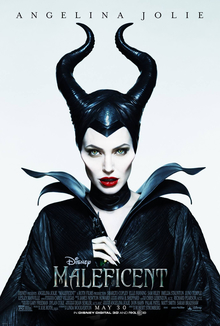
Fifty-five years after Eleanor Audley gave a voice to one of Disney’s most iconic villains, Maleficent returns to the screen with Angelina Jolie portraying the Mistress of All Evil. Or so it would seem. Disney’s “Maleficent” presents viewers with the story of “Sleeping Beauty” through the perspective of the titular villain. However, where the film succeeds in cinematography and setting/set design, it falls flat in regards to its characters and plot.
“Maleficent” is quite amazing to look at. It’s dark, beautiful and grand, with quite a few well done camera angles, especially during the latter half of the movie.  
 Maleficent’s magic expresses her purposes: taking a malevolent green glow when being used for evil and a lighter, yellow glow for her benevolent side. And the magic of the three fairies is also customized to their personalities, other than just the red, blue and yellow glows from the original.
There is also good juxtaposition between the Moors (home of the magical creatures), which is almost always portrayed as a colorful, vibrant place, with the human kingdom, which is foreboding, dark and gloomy.
But while that juxtaposition is done well, it only furthers the problems with characterization. Every character is given an alternate interpretation, becoming the polar opposite of who they were in the original story. It doesn’t work very well, mainly because it feels like it was done simply for the sake of doing so. This is most obvious in King Stefan and Maleficent herself.
King Stefan is not a reasonable authority figure who misses his daughter. Instead, he’s incredibly paranoid and waging a war for his own pride and ambition. He has no interest in the well-being of his subjects and when Aurora shows back up, he’s rather indignant and shows zero affection. In the same vein, Disney’s most famous chaotic evil villain is turned into a misunderstood lawful neutral anti-hero. Rather than the Mistress of All Evil, she is a betrayed lover who desires revenge and eventually recants. She is also given an unexplained weakness that has varying degrees of effectiveness depending on the scene.
The other characters don’t fare very well either. The three fairies become neglectful morons, Aurora is considerably bland and Prince Philip feels hurriedly written into the story as an afterthought. The only somewhat likeable character is Maleficent’s raven, Diaval, who is given human form and is the main source of the film’s sarcasm.
As for the story itself, the entire second half of the film changes every single plot point from the original story and seems completely unnecessary. The film rushes itself through the first half, where Maleficent becomes a villain in the blink of an eye to get to the second half, which has a gradual build into the aforementioned anti-hero who eventually saves the story by deconstructing the meaning of true love.
Despite all its problems, the film is very well acted, especially with Jolie. She is able to take the inflection and mannerisms Eleanor Audley gave the original Maleficent and make them her own. And even though Aurora’s character is quite bland, Elle Fanning at least tries to make her a likeable character. Sam Riley also was able to do very well in giving character to a raven magically turned into a man.

This film could have been so much better had it focused on the first half, giving Maleficent a more gradual descent into villainy instead of having her take a diving leap off the slippery slope. Unfortunately, the second half is something we’ve all seen before and it brings nothing new to the table.

With the revamped system, Maleficent comes in at #2, but doesn't pass either edge. 

Monday, May 5, 2014

The Black Cauldron

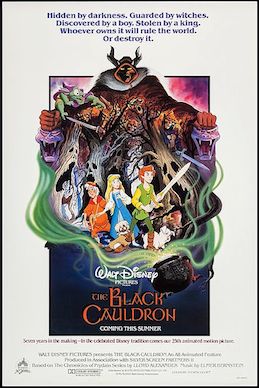
File:The Black Cauldron poster.jpgIn the 1980s, the Disney Animation Studio was having a bit of a tough time. They didn’t have many big hits like they did in the 40s and 50s and their President, Ron Miller, wasn’t very well liked by employees. It probably didn’t help that he married Disney’s only daughter. He was ousted from his position and replaced with Michael Eisner in 1984. Why is this important in a blog reviewing the animated films? Well, the first film he had control over as CEO was The Black Cauldron. Based off the first two books of Lloyd Alexander’s The Chronicles of Prydain, Eisner didn’t like the direction the film was going and stepped into perform some executive meddling. And became not only Disney’s most forgotten film, but one of their biggest failures. It nearly drove the animation studio out of business. It was the first Disney movie to warrant a PG rating, have no singing, and make use of CGI. Sierra also made it into a computer game and it was the inspiration for the Spyro the Dragon reboot in 2006. Make of that what you will.
Anyway, film tells the story of Taran (Grant Bardsley), an assistant pig keeper who wants to be a great warrior. He’s charged with hiding Hen Wen, a pig who has the power to tell the future. But the Horned King (John Hurt) wants her so she can uncover the location of the Black Cauldron so he can bring to live an army of undead warriors to conquer the world.
Along the way, he meets, the cowardly glutton Gurgi (John Byner), Princess Eilonwy (Susan Sheridan), and the minstrel Fflewddur Fflam (Nigel Hawthorne).

From my past reviews, you would probably be surprised to know that I quite enjoy dark works that fall heavily onto the cynical side of the scale. So, know I really mean it when I say I so desperately wanted to like this movie. But, aside from the wonderful animation, there is nothing in this movie worth praising. Note, I had to read a few synopses of the actual books to do this review.
First off, Disney acquired the rights to all five books. So why start smack-dab in the second one and have some of the first? The first book as a whole better establishes Eilonwy’s royalty. In this film, you don’t see her kingdom and she doesn’t do anything that would that would make you even remotely think, “Yeah, she’s a princess.” At least start off with “The Book of Three” and have them come across her destroyed castle! Taran is also one of the whiniest characters I have ever seen in fiction. And I’ve watched the Star Wars prequels multiple times. He won’t shut up nor will he get over himself. In fact, his hubris is basically the reason Hen Wen runs off and is found by the Horned King. And the end of the film has him finishing character development where he realizes he’ll never be a great warrior. Someone tell the books, where he becomes high king in the final novel.
Then there’s Gurgi, who could possibly overtake Jar Jar Binks for most annoying fictional character. This guy could have been so much more. His Wikipedia character description in the books reads that he’s a “cross between man and beast, having long arms, covered with fur and leaves and ever hungry but really just a sort of a kind of a thing.” In the movie? He’s a short puffball with an annoying voice.
The classic Disney villains who are able to pull off disturbingly terrifying  and threatening attributes are also able to be grandiose, and have some sort of charm and amicability (or at least attempt to do so), like Maleficent, Medusa, and Cruella. The Horned King does none of that. There’s nothing that adds to his villainy to make him an interesting villain. At least Tremain was a complete sociopath and the queen from Snow White had vanity to explain why she was evil. He also really doesn’t DO anything other than send his lackeys out. And when he finally starts to get involved, he immediately loses. Funny thing that he’s billed as an incredibly powerful sorcerer. I read somewhere that he’s on the short list to get an appearance in Kingdom Hearts III. I hope not.
There’s also quite a few coincidences and plot holes. Why do the witches have the cauldron in the first place? Why do the heroes just happen across the one group of people that knows where the witches are? Why does the cauldron kill the person who freely enters it? (It’s implied it’s just that evil, but that’s lazy writing).
This movie could have been so much better had Disney decided to make a film based on The Book of Three first and then gone into The Black Cauldron instead of having most of the latter and throwing in some of the former. Better yet, this should have been a live action Touchstone film. 


Final Call: Terrible on every account. Better than Victory Through Air Power, but that’s not saying much. #31. 

Wednesday, April 23, 2014

Sleeping Beauty

Sleeping beauty disney.jpg
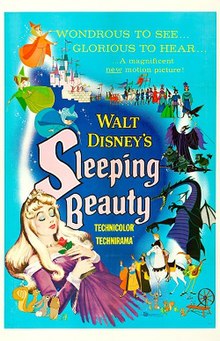
In 1959, the Walt Disney Company produced its last fairy tale adaptation for 30 years. Based on the stories La Belle au bois dormant by Charles Perrault and Little Briar Rose by The Brothers Grimm, Sleeping Beauty was released on January 29, 1959. The film’s score was based on arrangements and adaptations from the Tchaikovsky ballet. It was also the first animated film to use the Super Technirama 70 widescreen process. This wouldn’t happen again for 54 years.

When King Stefan (Taylor Holmes) and Queen Leah (Verna Felton) welcome the birth of their daughter, Princess Aurora, the kingdom’s subjects gather to pay her homage. She is also betrothed to Prince Phillip (Bill Shirley), the son of King Hubert (Bill Thompson). The good fairies Flora (Felton), Fauna (Barbara Jo Allen), and Merryweather (Barbara Luddy) bless the child with the gifts of beauty and song, but the evil fairy Maleficent (Eleanor Audley) appears to curse the infant to death by pricking her finger on a spinning wheel before her sixteenth birthday is over. Merryweather weakens the curse, changing it into a deep sleep, only revered by true love’s kiss.
King Stefan orders all the spinning wheels to be burnt and the three fairies take Aurora into the forest until her sixteenth birthday passes.
The years pass and on her sixteenth birthday, Aurora meets Prince Phillip while out in the forest and fall in love without knowing who each other are. She rushes home and finds out she is the princess. But Maleficent’s raven has found them.
Aurora is taken back to the palace, but is lured into a secret passageway to fulfill the prophecy. The fairies place a charm to make everyone else fall asleep as well until the spell is broken. They overhear that Prince Phillip met Aurora in the forest and went back to see her, but was taken by Maleficent.
The fairies realize this, free him and help him get to Aurora. Maleficent transforms into a dragon, but Philip kills her, and enters the palace to awaken Aurora. He does so and the two live happily ever after.

Production for Sleeping Beauty began in 1951, with most of the work being centered on the art and music. This is quite evident as those two aspects are the best part of the film. The art is fantastic, with the backgrounds drawn to evoke a renaissance feel. This is quite different from most Disney films at the time, but this works rather well, considering the time period the film is set in. It makes it more authentic. The musical adaptations of Tchaikovsky’s ballet are also very well done.
The story is a bit different than the original fairy tale. One aspect of the original tale includes the prince’s mother being an ogress who means to eat their children and eventually cooks herself. This would have made an interesting movie, but would have been a terrible choice for Disney. The directors and Disney made the right choices of what to include and cut and ended up making a great adaptation.
On the other hand, the characterization for the film is lacking. While Prince Phillip is the first Disney Prince to actually do something, he’s a very bland character who doesn’t say anything for the final half of the film. The same goes for Aurora. Granted she does put on a brave face when she finds out her entire life is a lie, but she doesn’t really do much other than sing, look nice, and (of course) fall asleep. But where those two fail, Maleficent succeeds not only as a great villain for the film, but one of Disney’s best. She’s terrifying and irrational, considering since she doomed an infant to death for not being invited to a party. But she also has her sane and subtle moments that give her some depth.


Final Call: Great animation, music and story choices. The main characters may be boring and bland, but Maleficent is one of the best villains made by Disney. It passes the Edge of Satisfaction but doesn’t get too far in. #6.