Showing posts with label 1989. Show all posts

Friday, August 15, 2014

Dead Poets Society

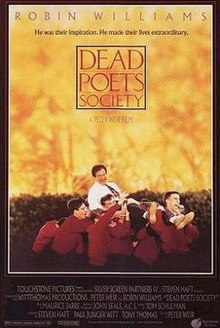
Dead poets society.jpgBased on scriptwriter, Tom Schulman’s life at the Montgomery Bell Academy in Nashville, Dead Poets Society was released in June 1989. Starring Robin Williams, Robert Sean Leonard, Ethan Hawke, Josh Charles, Gale Hansen, Norman Lloyd and Kurtwood Smith, it grossed over $230 million and won the award for Best Original Screenplay. Williams was also nominated for Best Actor, Director Peter Weir was nominated for Best Director and the film was nominated for Best Picture, but lost to Driving Miss Daisy.

In 1959, Welton Academy hired John Keating (Williams) as the new English teacher for the upcoming school year. Inspiring his students to go against the flow and be themselves, he makes poetry cool and rebellious. A group of his students (Leonard, Hawke, Charles, Hansen, James Waterston and Allelon Ruggiero) also form a group called the Dead Poets Society, sneaking out at night to read poetry in a secluded cave.

I’ll never forget the first time I saw this film, in the middle of my sophomore year high school English class at the beginning of a unit on poetry. I enjoyed it back then and I always watch at least some of it when I come across it on TV. Dead Poets Society is one of Williams’ best acted films with him alongside a great cast, incredible writing and good cinematography.
Ebert said Williams spoiled the film by occasionally veering into his comedic persona. He failed to understand the character. While Keating did have his comedic moments, they diverted from his mostly serious and instructive persona. In other words, Williams made him into a normal person who liked to insert a little humor into a serious lesson. Furthermore, the moments where he’s seriously teaching completely overshadow those comedic moments, especially during the whole improvised poetry scene with one of his students calling Walt Whitman a “sweaty-toothed madman.”
The above scene might also be one of the best scenes in the entire film in regards to the writing and cinematography as well. The lines from the improvised poem and the spinning camera do really well in cementing the scene as a lesson Keating gives the student in really seizing the moment and living out his first lesson of carpe diem. The final shot is also perfect, with the students standing in solidarity on their desks. It shows that Keating’s lesson of seeing the world differently, being themselves and going against the flow did get through to them and that they will act it out.
That brings forth the message of the film, which, yes, it’s blatant and whacks the viewer upside the head. But it’s one of those films that’s so well made, the viewer doesn’t care they were just assaulted with a heavy idea.

Dead Poets Society is a great film and definitely one of Williams’ best. 

Monday, July 21, 2014

Back to the Future II

Back to the Future Part II.jpgFour years after the success of Back to the Future, Zemeckis decided to make two more. The first sequel, Back to the Future Part II picks up exactly where the first film left off. With almost everyone reprising their roles, plus Flea as Needles, the film grossed over $300 million and was the third-highest grossing film of 1989.

Doc Brown (Christopher Lloyd) takes Marty (Michael J. Fox) and Jennifer (Elisabeth Shue) to 2015 to save his son from trouble. Successful, they find the elderly Biff Tannen (Thomas F. Wilson) stole the DeLorean and made his younger self rich. Now with 1985 made into a dystopia, Marty has to return to 1955 to set right what once went wrong.

Yes, this film has launched a few memes that have gotten very old, very fast. But that doesn’t mean it’s a bad movie. In fact, it’s almost as good as the first.
The future portion of the film looks very good and it’s quite noticeable that a lot of effort went into making it look like it actually is the future. And the clock tower still not being fixed is an amusing addition. The DeLorean also has a couple great additions, like using trash as fuel and it being able to fly. Once again, just how these work isn’t explained, but it doesn’t need to be. It’s future tech!
The alternate 1985 is also great. Everyone’s had the dream of being able to control the country or world and this shows what would happen if someone so self-absorbed and narcissistic as Biff did so. It also displays the relationship between the abuser and the abused quite well in how Biff controls Lorraine. And since Biff controls everything, she can’t go anywhere anyway.
In going back to 1955, Marty has to stay out of sight from his past self, currently working on the events of the first movie. However, the movie never strains itself in how he continues to avoid himself.
There is a slight continuity error though. In the first film, Doc wants to see who wins the next few World Series and make a bit of money. But in this one, he explicitly condemns it and says he didn’t invent the time machine to win at gambling. He might have had development between films but everything else about him is the same.

Not better than the first, but still passes the Edge of Satisfaction.
#2

Saturday, May 10, 2014

The Little Mermaid

Movie poster the little mermaid.jpg
November 17, 1989 saw the beginning of the Disney Renaissance, with its first film being a retelling of Hans Christian Andersen’s tale The Little Mermaid. Starring Jodi Benson, Pat Carroll, Samuel E. Wright, and Buddy Hackett, the film was the first to feature music by Alan Menken. It was the 13th highest grossing film of 1989, won the Academy Awards for Best Song (Under the Sea) and Best Score, earned a Saturday morning prequel series, a direct to video sequel and prequel, and was popular enough to warrant an appearance in the Kingdom Hearts franchise as well as a ride at Disney California Adventure.

A 16-year-old mermaid named Ariel (Benson) is one of the daughters of Triton (Kenneth Mars), King of the Sea. She is unique in that she is fascinated by humans. But Triton hates them. One night, she ventures to the surface and falls in love with the human Prince Eric (Christopher Daniel Barnes). She rescues him after his ship is destroyed in a storm, but she becomes desperate to become a human.  
She visits the sea witch Ursula (Carroll) to become a human. She gives up her voice to become human and agrees that if she can get him to fall for her in three days, she’ll become permanently human. If not, she will be Ursula’s slave.

While Prince Phillip of Sleeping Beauty was the first Disney Prince to actually do something, Prince Eric is the first Disney Prince to do it all on his own power. He didn’t need any magic to steer his ship into Ursula’s Final Form, he just did it. And it must be stated just how determined he was. Once he finally realized he had the girl he was after, he just wasn’t going to let her go without fighting. He doesn’t care that he’s up against a gigantic evil octopus. And he was using a ship that was previously wrecked that came up when she did it. He’s crafty enough to use whatever he can get.
Ursula is the octopus version of Ratigan. She’s evil, but she’s also smart. She words the contract in a way that she would be all but guaranteed to come out on top after she shape shifts into a woman. She just didn’t count on an insane seagull to ruin her plans. Also, she actually seems to care for her minions, considering she flies into a rage when Flotsam and Jetsam are blasted. But, her hubris was her downfall. In her breakdown after her plan has failed, she makes herself grow to epic proportions, giving Eric the target he needed.
Triton is also excellently characterized as a parent. He’s got a hatred of humans and he’s projecting that onto Ariel. We only know that he hates them because they eat fish, but the origin of that hatred isn’t revealed. And so we understand that he’s trying to be the best father he can be, he just isn’t able to correctly put into words just really why he doesn’t want Ariel up on the surface.
The side characters are also fun. Flounder is afraid of everything, but in the end won’t hesitate to help Ariel. Sebastian just wants to do his job as a court composer and when he’s given the task of looking after Ariel, he takes it, but doesn’t want to upset the king and even tries to hide the fact that she has a statue of Eric. And Scuttle is hilarious. He’s insane and doesn’t know a thing about what he says is his expertise. But he’s able to rally fish, dolphins and birds to attack Ursula in disguise.
The animation in this film is stellar, with it truly feeling like it’s a Disney movie with really good songs. There’s not one that doesn’t feel like it doesn’t fit.
On the other hand, my main issue with this movie is our main character herself. Ariel wants what she wants. And she’s going to do anything it takes to get it. Normally that’s not a bad trait, except when you not only gamble your soul to do it as well as almost risk the entire ocean coming under the control of Ursula. She is the cause of everything and despite that, she ends up with everything she wants with absolutely zero repercussions. Though there’s a short time in the climax when she apologizes, it’s not because she’s really sorry that she caused everything, she’s sorry that it all went south. Furthermore, she is willing to give up everything that makes her who she is for love. That's a surefire way to end up hating yourself. The film isn’t trying to tell us that we can do whatever we want with no consequences or that we should lose what makes us who we are in the quest for love, but it ends up coming out. And that’s a glaring fault.

Yet, she’s absolutely adorable when she can’t talk and is just enthralled in the wonder of seeing everything on land. It’s heartwarming to see her unbridled joy at what’s going on around her. 

Final Call: A good start to the Renaissance, despite the faults provided by Ariel. #10