Showing posts with label Piglet. Show all posts

Saturday, September 6, 2014

Pooh's Heffalump Movie

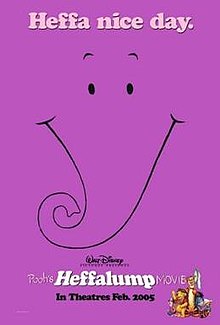
Poohs heffalump movie.jpgIn 2005, DisneyToon Studios theatrically released Pooh’s Heffalump Movie, another original story. Starring Jim Cummings, John Fiedler, Kath Soucie, Nikita Hopkins, Ken Sansom, Peter Cullen, Kyle Stanger, and Brenda Blethyn, the film grossed $52.8 milliom. It also got a direct-to-video sequel later that same year.

Winnie the Pooh (Cummings) and his friends hear a strange noise and find a large, perfectly circular set of footprints in the Hundred Acre Wood. Jumping to the conclusion that they’re from a heffalump, they organize an expedition to catch it, but Roo (Hopkins) is disappointed that he’s told to stay behind. However, he slips out on his own in search of the creature.

While this film really shouldn’t have been given a theatrical release, it isn’t all that bad and would have been much better being released direct to video.
Pooh’s Heffalump Movie does have a fun story, with Roo wanting to be a part of the expedition that catches the heffalump, only to be the first one to run into it. And even then, it takes the classic Pooh lore as the heffalumps, which have been established as being inherently evil, aren’t. Lumpy’s just a curious little kid and his mother is actually really helpful.
On the other hand, the songs can get annoying and feel really out of place, especially when Carly Simon is singing them.

It’s not bad, but it’s not great. #70

Tuesday, July 29, 2014

Piglet's Big Movie

Piglets big movie teaser.jpgDisneyToon Studios produced another Winnie the Pooh theatrical film in early 2003. Centering on Piglet, Piglet’s Big Movie starred John Fiedler, Jim Cummings Nikita Hopkins, Ken Sansom, Peter Cullen, Kath Soucie, and Tom Wheatley. Also with more music by Carly Simon. It made $6.2 million.

Adapting three more A. A. Milne stories to make Piglet (Fielder) the hero of them, the characters in the Hundred Acre Wood search for Piglet. In the meantime, they reminisce about all the things Piglet has done. They remember when Kanga (Soucie) moved into the area, an expedition to the North Pole, and the building of the House at Pooh Corner.

This might actually be a good example of a frame story done well. It’s got entirely original sequences with a frame that actually makes a bit of sense.
All the individual stories fit well and are fun to watch. They also contain some amount of character development. At least the first one does. Rabbit reacts to Kanga and Roo moving in as you would expect a white neighborhood to react to a black family moving in during the mid-50s. But it’s after Rabbit spends time with Roo that he takes everything back.

The music is also good, especially with the original works sung by Simon, the only problem is at the very end. When she gets a music video during the first part of the end credits. It takes you out of the film and doesn’t really serve any purpose other than to fill time or look cool. It does, it just seems unnecessary.

 #53

Friday, June 13, 2014

The Tigger Movie

The Tigger Movie film.jpgIn 2000, Disney would release the first theatrical Winnie the Pooh film to not be a collection of shorts as well as not centered around the bear. The Tigger Movie was also the first Disney movie to feature music by the Sherman Brothers since Bedknobs and Broomsticks. Starring all the regular voice actors, the film did moderately well at the box office.

The film centers on Tigger who feels lonely about being “the only one” and decides to search for his family.

Simple concept for a film that centers on what previously was a side character. Usually, Tigger loves being the only one of his kind around. But when he doesn’t have anyone to bounce with, he realizes how alone he really is and wonders what happened to his kind. And most of the film just pushes him down more and more with misunderstandings. He thinks he’s “reading between the lines” with the letter that his “family” is coming, when they’re really not. And when the gang shows up pretending to be them, when he finds out, he won’t let them explain, so he goes off into a blizzard. It makes sense, he believes he’s seeing his family for the first time and is dejected that it wasn’t really them. It’s what makes the main theme of the movie so great when it comes around.
Tigger comes to realize that he may be the only Tigger, but he does have a family in the friends that have stuck by him through everything. And it may seem tacked on, until you realize that they didn’t like seeing Tigger so upset at not having a family, so they orchestrated a letter and then faked being his family. Then they went to go find him in a snowstorm. Everything they do shows how much they care for him.
There’s not much else to say about the film. The music is good and Christopher Robin shows up at the very end of the film, even though he had absolutely no business even being there.

#39, but does cross the Edge of Satisfaction

Sunday, June 8, 2014

Seasons of Giving

Winnie the Pooh got another direct to video film for Thanksgiving 1999. Seasons of Giving included an original story and two episodes from The New Adventures of Winnie the Pooh. It also starred all the voices of the series.

Tigger (Jim Cummings) wants to ski, but Pooh (Cummings) and Piglet (Steve Schatzberg) point out that there’s no snow and when they go ask Rabbit (Ken Sansom) what day of the year it is, his calendar pages blow from November to Groundhog Day. Since they don’t have a groundhog, they use piglet, who can’t see his shadow.
During Thanksgiving, Rabbit changes the dinner that everyone brought and assigns them different tasks to make the dinner a traditional thanksgiving dinner
On Christmas Eve, everyone is decorating Rabbit’s house and Tigger arrives with a letter from Kessie (Laura Mooney), a bird rabbit took care of. He tells everyone the story of how he found her.

Not much to say about this one. All the characterization is still intact from the original film, albeit a little bit exaggerated.
The individual stories are good and bring out the best of each character, especially the last one and Rabbit’s neuroticism with taking care of someone.
However, the original songs leave a little bit to be desired. They’re not as good as they could be, but they’re ok. I don’t think the Sherman Brothers could make a bad song.

#40

Tuesday, May 27, 2014

Pooh's Grand Adventure: The Search for Christopher Robin

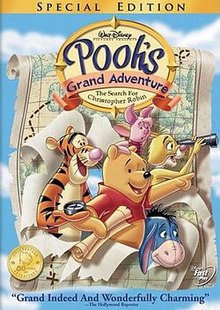
PGATSFCR.jpgThe success of The Many Adventures of Winnie the Pooh prompted Disney to make a direct sequel in 1997. Pooh’s Grand Adventure: The Search for Christopher Robin was an entirely original story, not based on any of Milne’s original works. Starring Jim Cummings, John Fiedler, Ken Sansom, Paul Winchell, Andre Stojka and Brady Bluhm, the film is the first Winnie the Pooh movie to have its own special edition.

Christopher Robin (Bluhm) spends the last day of summer with his friend, Winnie the Pooh (Cummings), while keeping a secret from him.
When Pooh wakes the next day, he discovers a note from Christopher Robin attached to a pot of honey. Owl (Stojka) deciphers the message, which had been splattered with honey and says that Christopher Robin has been taken to a horrible place called the Skull by the Skullosaurus. He equips the group with a map and they set off on an adventure to save their friend.

As a direct sequel, the continuity in this film is astounding. The conversation that takes place at the beginning is the exact same conversation, word for word, from the end of the first Winnie the Pooh movie.
Though the characters start out all the same from the first movie, all the trials they go through in their search leave them more rounded. During the course of the film, they are broken by their greatest flaws and fears. Piglet’s fear of heights neuters him, Tigger’s fear of not being able to bounce high cripples him and Rabbit is left near catatonic after his leadership skills are shown to be nil. But it’s after they find Christopher Robin that that they realize what he told Pooh at the beginning is true. They’re better than they give themselves credit for and at the end of the film, they’ve conquered those fears and flaws.
It’s also interesting to see the juxtaposition of how the “Great Unknown” appears before and after they’ve found Christopher Robin. Before, it’s how Owl described it: dark, treacherous and foreboding. But afterwards, it’s like every other spot in the Hundred Acre Wood. It’s changed because they’re not afraid anymore and find that there was no real reason to be afraid in the first place.
While the songs aren’t all bad, only the first two are actually worth writing home about.

#23

Thursday, May 1, 2014

The Many Adventures of Winnie the Pooh

File:The Many Adventures of Winnie the Pooh.jpg
In the late 60s and early 70s, The Disney Company released three animated featurettes based on A. A. Milne’s Winnie the Pooh books. On March 11, 1977 they were released as one animated musical feature, with one new addition, as The Many Adventures of Winnie the Pooh. Starring Sterling Holloway, John Fiedler, Bruce Reitherman, and Timothy Turner, the company eventually released a sequel in 2011.

The narrative is told in the form of the narrator (Sebastian Cabot) reading the original books, occasionally interacting with the characters.
The first story, Winnie the Pooh and Honey Tree, involves Pooh (Holloway) trying to get honey from a tree filled with bees. He disguises himself in mud and pretends to be a black rain cloud as Christopher Robin (Reitherman, Jon Walmsley, and Turner) furthers the con. Unsuccessful, Pooh visits Rabbit (Junius Matthews) for some honey and gets stuck in his front door. After a few days, Pooh is able to be pushed out and gets tuck in the honey tree.
The second story, Winnie the Pooh and the Blustery Day, takes place on a very windy day. Piglet (Fiedler) turns into a kite due to his scarf unraveling and Eeyore’s (Ralph Wright) house breaks while Pooh tries to hold on. Owl’s (Hal Smith) house also blows over and Eeyore begins to seek out a new house. That night, Tigger (Paul Winchell) surprises pooh and warns him about Heffalumps and Woozles that steals honey. During a flood, Piglet is washed out of his house Pooh and Owl help Piglet and Christopher Robin organizes a hero’s party for Pooh. However, Eeyore finds Piglet’s empty house and announces that he found a new home for Owl. Piglet lets him stay and moves in with Pooh.
The third story, Winnie the Pooh and Tiger Too, has Tigger annoying everyone with his bouncing, so Rabbit plans to lose him in the woods. However, Rabbit gets himself, Pooh and Piglet lost. Rabbit wanders away, and Pooh and Piglet are found again by Tigger, who eventually finds Rabbit as well. During the winter, Tigger and Roo (Clint Howard and Dori Whitaker) get stuck up a tree and are found by Pooh and Piglet. Christopher Robin uses his coat as a net to get them to jump down. Roo jumps, but Tigger has to be helped by the narrator tipping the book.
The final story, based on the final chapter of The House at Pooh Corner is simply a discussion with Christopher Robin and Pooh about remembering the time they had together.

Another package film. But this one is a little bit different as it involves all the same characters and is framed by a narrator going between chapters. This makes it the smoothest package film the company has put out and the fourth wall jokes actually make sense, with explanations that Owl went on and on for 20 or so pages, that Pooh allowed the narrator to continue simply because he was in the next chapter and that Tigger was only able to get out of the tree thanks to the narrator. The way it’s done adds to the film’s sense of humor, instead of just being a way to shoehorn something in like The Aristocats did. Also, the entire “Heffalumps and Woozles” song is another Disney Acid Trip. But it’s much better and much weirder than Dumbo’s “Pink Elephants on Parade.”
The original books were based off of Milne’s own son, Christopher, and his interactions with his stuffed animals. This stays true to that. The book the story takes place in is Christopher Robin’s copy of that same book and the opening shot of the film is in his room. As such, all the characters in the film are the creation of Christopher’s imagination. The point is, that all the characters seem one dimensional. Pooh is slow witted, loyal, friendly, and constantly hungry, Tigger is hyperactive and oblivious to his own surroundings, Rabbit is full of himself and quickly gets weary to the hijinks of everyone else, Owl isn’t as intelligent as he thinks he is and often drones on and on, Piglet is paranoid and easily excited, Kanga is the overprotective mother and Roo is the brave kid. Only having one facet to their characters actually works in the film’s favor. Christopher is a young boy and young children don’t often give imaginary friends a lot of depth. This gives the film more believability.
Furthermore, the final part of the movie is incredibly deep with Christopher and Pooh going into what makes friendship and memories without derailing Pooh’s character. And then it ends. But this works really well to tie up the film, which is simply the misadventures of a boy and his imaginary friends. It’s not overtly grand, there’s no fantastic action, and the characters don’t really learn anything. But when you had an imaginary friend as a child, did that happen to you?

Final Call: just a slice of life in the Hundred Acre Wood. #5.