In the late 60s and early 70s, The Disney Company released
three animated featurettes based on A. A. Milne’s Winnie the Pooh books. On March 11, 1977 they were released as one animated
musical feature, with one new addition, as The
Many Adventures of Winnie the Pooh. Starring Sterling Holloway, John
Fiedler, Bruce Reitherman, and Timothy Turner, the company eventually released
a sequel in 2011.
The narrative is told in the form of the narrator (Sebastian
Cabot) reading the original books, occasionally interacting with the
characters.
The first story, Winnie
the Pooh and Honey Tree, involves Pooh (Holloway) trying to get honey from
a tree filled with bees. He disguises himself in mud and pretends to be a black
rain cloud as Christopher Robin (Reitherman, Jon Walmsley, and Turner) furthers
the con. Unsuccessful, Pooh visits Rabbit (Junius Matthews) for some honey and gets stuck in his front door. After a few days,
Pooh is able to be pushed out and gets tuck in the honey tree.
The second story, Winnie the Pooh and the Blustery Day,
takes place on a very windy day. Piglet (Fiedler) turns into a kite due to his
scarf unraveling and Eeyore’s (Ralph Wright) house breaks while Pooh tries to
hold on. Owl’s (Hal Smith) house also blows over and Eeyore begins to seek out
a new house. That night, Tigger (Paul Winchell) surprises pooh and warns him
about Heffalumps and Woozles that steals honey. During a flood, Piglet is
washed out of his house Pooh and Owl help Piglet and Christopher Robin
organizes a hero’s party for Pooh. However, Eeyore finds Piglet’s empty house
and announces that he found a new home for Owl. Piglet lets him stay and moves
in with Pooh.
The third story, Winnie
the Pooh and Tiger Too, has Tigger annoying everyone with his bouncing, so
Rabbit plans to lose him in the woods. However, Rabbit gets himself, Pooh and
Piglet lost. Rabbit wanders away, and Pooh and Piglet are found again by
Tigger, who eventually finds Rabbit as well. During the winter, Tigger and Roo
(Clint Howard and Dori Whitaker) get stuck up a tree and are found by Pooh and
Piglet. Christopher Robin uses his coat as a net to get them to jump down. Roo
jumps, but Tigger has to be helped by the narrator tipping the book.
The final story, based on the final chapter of The House at Pooh Corner is simply a discussion
with Christopher Robin and Pooh about remembering the time they had together.
Another package film. But this one is a little bit
different as it involves all the same characters and is framed by a narrator
going between chapters. This makes it the smoothest package film the company
has put out and the fourth wall jokes actually make sense, with explanations
that Owl went on and on for 20 or so pages, that Pooh allowed the narrator to
continue simply because he was in the next chapter and that Tigger was only
able to get out of the tree thanks to the narrator. The way it’s done adds to
the film’s sense of humor, instead of just being a way to shoehorn something in
like The Aristocats did. Also, the
entire “Heffalumps and Woozles” song is another Disney Acid Trip. But it’s much
better and much weirder than Dumbo’s “Pink
Elephants on Parade.”
The original books were based off of Milne’s own son,
Christopher, and his interactions with his stuffed animals. This stays true to
that. The book the story takes place in is Christopher Robin’s copy of that
same book and the opening shot of the film is in his room. As such, all the
characters in the film are the creation of Christopher’s imagination. The point
is, that all the characters seem one dimensional. Pooh is slow witted, loyal,
friendly, and constantly hungry, Tigger is hyperactive and oblivious to his own
surroundings, Rabbit is full of himself and quickly gets weary to the hijinks
of everyone else, Owl isn’t as intelligent as he thinks he is and often drones
on and on, Piglet is paranoid and easily excited, Kanga is the overprotective
mother and Roo is the brave kid. Only having one facet to their characters
actually works in the film’s favor. Christopher is a young boy and young
children don’t often give imaginary friends a lot of depth. This gives the film
more believability.
Furthermore, the final part of the movie is incredibly deep
with Christopher and Pooh going into what makes friendship and memories without
derailing Pooh’s character. And then it ends. But this works really well to tie
up the film, which is simply the misadventures of a boy and his imaginary
friends. It’s not overtly grand, there’s no fantastic action, and the
characters don’t really learn anything. But when you had an imaginary friend as
a child, did that happen to you?
Final Call: just a
slice of life in the Hundred Acre Wood. #5.
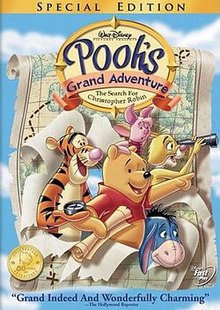 The success of The
Many Adventures of Winnie the Pooh prompted Disney to make a direct sequel
in 1997. Pooh’s Grand Adventure: The
Search for Christopher Robin was an entirely original story, not based on
any of Milne’s original works. Starring Jim Cummings, John Fiedler, Ken Sansom,
Paul Winchell, Andre Stojka and Brady Bluhm, the film is the first Winnie the
Pooh movie to have its own special edition.
The success of The
Many Adventures of Winnie the Pooh prompted Disney to make a direct sequel
in 1997. Pooh’s Grand Adventure: The
Search for Christopher Robin was an entirely original story, not based on
any of Milne’s original works. Starring Jim Cummings, John Fiedler, Ken Sansom,
Paul Winchell, Andre Stojka and Brady Bluhm, the film is the first Winnie the
Pooh movie to have its own special edition. 
