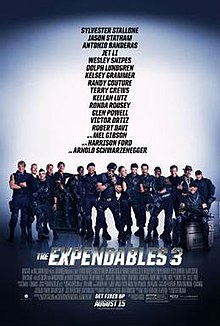
 Four years after Sylvester Stallone paid tribute to the
action films of the 1970s and 1980s with The Expendables, the series’ third
installment has been released. Directed by Patrick Hughes, the film features
returning cast members Stallone, Jason Statham, Jet Li, Dolph Lundgren, Randy
Couture, Terry Crews and Arnold Schwarzenegger with Kellan Lutz, Ronda Rousey,
Glen Powell, Victor Ortiz, Robert Davi, Kelsey Grammer, Wesley Snipes, Mel
Gibson, Antonio Benderas, and Harrison Ford.
Four years after Sylvester Stallone paid tribute to the
action films of the 1970s and 1980s with The Expendables, the series’ third
installment has been released. Directed by Patrick Hughes, the film features
returning cast members Stallone, Jason Statham, Jet Li, Dolph Lundgren, Randy
Couture, Terry Crews and Arnold Schwarzenegger with Kellan Lutz, Ronda Rousey,
Glen Powell, Victor Ortiz, Robert Davi, Kelsey Grammer, Wesley Snipes, Mel
Gibson, Antonio Benderas, and Harrison Ford.
After Conrad Stonebanks (Gibson), former member and
co-founder of the Expendables has surfaced and is determined to destroy the
team, causing Barney Ross (Stallone) to recruit old and new allies to take him
down once and for all.
As with the first two, Expendables 3 is not one of those
movies watched for the plot, which is paper-thin. But, while the film has an
even larger cast of talented actors offering no small amount of action, Expendables 3 just isn’t fun. There’s far too many characters to care about,
which really overshadows Gibson’s somewhat enjoyable villainous performance as
well as Banderas’ humorous acting as the manic Galgo. Furthermore, in an effort
to top itself over the previous two films, it goes beyond overkill.
Gibson as Stonebanks is moderately enjoyable. He’s one of
two new characters the film tries to give depth to with a backstory, by making
him the disillusioned co-founder of the Expendables who betrayed the team to
sell illegal weapons. He has just the right mix of smugness and insanity to
make him an enjoyable villain, such as when he’s acting coy to a buyer for his
weaponry about having nuclear weapons but not wanting to sell them. Banderas is
the other new character with something of a past as the lone survivor of a
botched mission with the Spanish Armed Forces. He joins Ross so he can make
peace with his survivor’s guilt. The character is quite humorous and manic in
his desire to be part of another team and love for killing enemies. However,
with the film having nine new characters alongside nine returning characters,
Gibson is overshadowed and Banderas is underutilized. To its credit though, the
film does attempt to give Doctor Death (Snipes) and John Smilee (Lutz) pasts,
but Death is just a former Expendable who spent eight years in a secret prison,
making him a little loopy and Smilee is simply an ex-marine with an attitude
problem.
The film also tries too hard to top itself from the previous
two, but it goes horrendously overboard. “Expendables” had the team up against
a dictator and his soldiers. In “Expendables 2” the team fought an arms dealer
and his mercenary group. “Expendables 3” has Stonebanks setting a country’s
entire army against the heroes. And they all manage to get through with
everyone and everything completely intact. There’s nothing wrong with heroes
facing insurmountable odds but when they don’t seem to have too a hard time
facing them, the film becomes far less enjoyable. It should feel like there’s
more of a challenge when 15 men and a helicopter go against multiple ground
troops, tanks and helicopters. Yin Yang (Lee), Drummer (Ford) and Mauser
(Schwarzenegger) showing up in the middle of the fight in the helicopter was
also telegraphed a mile away and could have been a better moment had the film
not shown them coming in two other scenes.
Expendables 3 isn’t awfully terrible. But by no means can
it be considered good in any way. It’s one of those movies someone watches when
there’s two hours to kill, but really nothing better to do. There’s a few good
moments and a couple decent characters, but they can’t really carry the entire
film. The first “Expendables” made sense. Stallone wanted to have fun with old
action actors by making a pumped up nod to the action films of the 70s and 80s.
But two sequels don’t make sense. And neither does a confirmed fourth one
that’s expected to have Pierce Brosnan and Hulk Hogan.
Expendables 3 won't drop into the Edge of Dissatisfaction, but it'll barely miss it and come in at #6 under Jersey Boys.

