Showing posts with label Kathryn Beaumont. Show all posts

Monday, April 21, 2014

Peter Pan

In the 1940s, Disney decided to make a fantasy-adventure film based off the play Peter Pan, or The Boy Who Wouldn’t Grow Up, by J. M. Barrie. Peter Pan was released February 5, 1953, with Kathryn Beaumont returning to voice Wendy and would again reprise the role in Kingdom Hearts. The film was also entered into the 1953 Cannes Film Festival.
PeterpanRKO.jpg 
The film opens as Tom Conway narrates that the actions taking place have happened before and will all happen again. George and Mary Darling (Hans Conried and  Heather Angel) are preparing to attend a party, when they are disrupted by the antics of John and Michael (Paul Collins and Tommy Luske) acting out a story from Peter Pan as told to them by their sister Wendy. Their father is fed up with the stories and declares that Wendy is too old to stay in the nursery with them and she is to have a room of her own. That night the children are visited by Peter Pan (Bobby Driscoll) who teaches them to fly with the help of Tinker Bell (Margaret Kerry). They head to Never Land.
A ship of pirates is anchored off of Never Land, commanded by Captain Hook (Conried) and his first mate, Mr. Smee (Bill Thompson). Hook wants revenge for Peter cutting off his hand, but is constantly scared of the crocodile that stalks him Hook forms a plan to find Peter’s hideout by using the knowledge of Indian princess, Tiger Lily (Corinne Orr).
 Despite Tinker Bell trying to have Wendy killed, they meet up with the Lost Boys who look to Peter as their leader. Tinker Bell’s scheme is found out and Peter banishes her for a week. John and Michael set off with the Lost Boys to find the Indians, but they are captured. The Indians believe them to be responsible for kidnapping Tiger Lilly. Big Chief (Candy Candido) warns that if she is not returned, they will be burnt at the stake.
Peter takes Wendy to see the mermaids, who try to drown her, but Hook arrives and they see that he and Smee have captured Tiger Lily. Peter and Wendy free her and Peter is honored by the tribe. Hook now tries to take advantage of Tinker Bell’s jealousy and tricks her to reveal the location, but Hook promises not to lay a finger or a hook on Peter. He locks her in a lantern.
Wendy and her brothers grow homesick and plan to return home. They invite the others to come and be adopted. The Lost Boys agree, but Peter is against growing up and refuses. They leave, but are captured by the pirates. They leave behind a Bomb to kill Peter and Tinker Bell learns of the trap in time to get away from him.
Peter rescues Tinker Bell from the rubble and they confront the pirates. They arrive just as the pirates are forcing everyone to walk the plank. Peter engages Hook in combat and humiliates him. Hook and the crew flee with the crocodile in pursuit. Peter commandeers the ship and flies it to London. The Lost Boys decide to return to Never Land after all.
Mr. and Mrs. Darling return to find Wendy sleeping at the open window, having no idea that they have been anywhere. Mr. Darling, who has relented about his earlier stance out the window and recognizes the ship from his own childhood.

Disney originally wanted to release Peter Pan after Snow White and the Seven Dwarfs, but couldn’t get the rights until 1940. And when the US entered the war, the studio was commissioned for propaganda and was in debt until 1947, when production once again commenced.
The reason I include all that is Peter Pan is a film that comes off as well thought out and produced. Waiting almost 15 years to produce the film certainly helped. It’s a very tight story with realistic characters and wonderful animation. A lot of the film’s charm also comes from its timing. Hook and Smee are a hilarious unintentional comedic duo. And yet, Hook still has a way to be very menacing.
And while the portrayal of the Indians in the film can be interpreted as racist, it’s harmless and endearing racism at worst. At best, they provide three great points in the film. Big Chief threatening to burn the Lost Boys at the stake is terrifying, Tiger Lily is an amazing dancer and “What Makes the Red Man Red” is arguably the best song in the movie.

Final Call: A tight film all around. Alice in Wonderland didn't spend much time as #3. 

Sunday, April 20, 2014

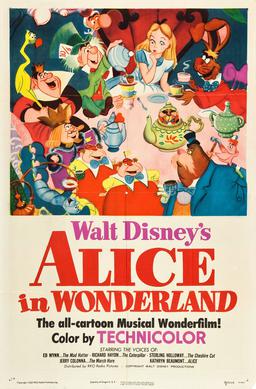
Alice in Wonderland

File:Alice in Wonderland (1951 film) poster.jpgIn 1951, Disney went from the fantasy love story to the bizarre irrational journey. Based on Lewis Carroll’s Alice’s Adventures in Wonderland and Through the Looking Glass, Alice in Wonderland premiered in New York and London on July 26, 1951. Kathryn Beaumont, the voice of Alice, would go on to reprise her role in Kingdom Hearts.

The film begins on a riverbank where Alice is growing bored of her older sister reading from a history book about William I. Her sister chastises Alice’s daydreaming and she tells her kitten, Dinah, that she would prefer to live in a nonsensical dreamland called Wonderland. She and Dina see a white rabbit (Bill Thompson) passing by, crying that he is late for an important date. Alice follows him down a rabbit hole and falls into a labyrinth. Her dress catches her fall and she begins to float down. She tries to follow the White Rabbit through a door (Joseph Kearns), who says she is too big to enter and advises her to drink from a bottle to shrink. She does so, but the door says he is locked and the key is still on the table. She eats from a cookie that makes her gigantic, which makes her cry tears that turn into puddles. The doorknob tells Alice there is a little liquid left in the shrink bottle, so she drinks it and shrinks into the bottle. She passes through the keyhole and meets the Dodo (Bill Thompson), Tweedledee and Tweedledum (J. Pat O’Malley), who tell her of the Walrus and the Carpenter.
Alice finds the White Rabbit at his house, but he believes she is his servant Mary Anne and asks her to fetch his gloves. She eats a cookie, grows into a giant again and gets stuck in the house. She is too big to pull herself out and the White Rabbit believes her to be a monster. He gets the Dodo and Bill the Lizard (Larry Grey) get her out and the two try to burn the house down. Alice escapes by shrinking down to insect size via carrot, where she meets flowers who sing but chase her away when they believe she is a weed. Alice is then instructed by a hookah-smoking Caterpillar (Richard Haydn) to eat part of his mushroom to grow back to her original size. She keeps some of the mushroom on hand.
Alice then meets the Cheshire Cat (Sterling Holloway) who advises her to visit the Mad Hatter (Ed Wynn), March Hare (Jerry Colonna) and the Dormouse (Jimmy MacDonald) who are hosting a mad tea party. They celebrate her unbirthday and the White Rabbit appears, but they destroy his pocket watch and throw him out. Fed up with the rudeness of the denizens of Wonderland, Alice decides to go home, but gets lost in the Tulgey Wood. The Cheshire Cat appears again and leads her into a hedge maze ruled by the Queen and King of Hearts (Verna Felton and Dink Trout). The queen orders the beheading of anyone who engrages her and invites Alice to a croquet match with flamingoes and hedgehogs.
The cat appears again and pulls a trick on the queen, which she accuses Alice of. She is put on trial and she remembers that she has the remains of the mushroom. She heats and grows again, which the king claims is forbidden. Now gigantic, Alice speaks her mind and insults the queen. However, she had eaten both sides and shrinks to her normal size. She flees, pursued by the queen, ordering an execution. The queen is joined by most of the characters until Alice happens across the doorknob, who tells her she is having a dream. Alice forces herself to wake up and the film ends as Alice, her sister, and Dinah head home.

Alice in Wonderland is a very interesting film. It’s more of a study on Alice and her journey through Wonderland than a story about Wonderland as a place and its inhabitants. The denizens of Wonderland are delightfully insane and have no qualms about living there. But Alice, having been used to the real world, finds the irrationality of the place quickly gets to be too much. And while every character she comes across is completely flat, that’s not a terrible thing for the film. It’s Alice’s perspective and she’s just trying to make sense of that which cannot be explained. Furthermore, you’re not supposed to care about the residents of Wonderland, you’re supposed to enjoy their hijinks. You’re supposed to care about Alice. Also the animation is quite good. A lot of the backgrounds are dark and washed out. But that just gives the colors of the characters situations in the foreground a cartoonier feel, which helps them to stand out.
Another thing I noticed. At its base, it seems to be telling its audience that dreaming and imagination leads to unfortunate consequences, which is a far cry from the message of Walt’s last film.  However, a closer look would show that the film means to say that imagination is fine and dandy, but living in that realm would break a normal person. Certainly we should dream and have a vigorous imagination. After all, Disney would have been nothing without his. But there needs to be a return to reality. Maybe I’m reading too much into the film.


Final Call: A good study on how a real person would fare in a world of nonsense. Crosses the Edge of Satisfaction and overtakes Bambi as #3.