Showing posts with label Fantasia. Show all posts

Thursday, June 12, 2014

Fantasia 2000

At the stroke of midnight of the year 2000, Disney released the first sequel that was in line with what Walt Disney originally envisioned. Performed by the Chicago Symphony Orchestra, Fantasia 2000 consisted of the same idea as its predecessor, plus celebrity appearances to introduce them. It starred Steve Martin, Itzhak Perlman, Bette Midler, Penn & Teller, James Earl Jones, Quincy Jones, and Angela Lansbury.
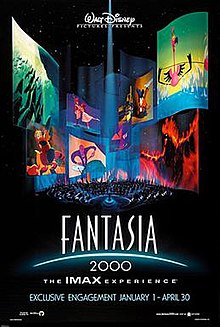
Fantasia2000 Poster.jpgThe segments consisted of Symphony No. 5 by Beethoven, which was paired with abstract shapes and patterns resembling butterflies and bats. Afterwards was the Pines of Rome, with humpback whales being able to fly and a calf is separated from its parents in an iceberg. Then it’s Rhapsody in Blue with 1930s New York City as a setting. Followed by Shostakovich’s Piano Concerto No. 2 set to the “Steadfast Tin Soldier. Next is The Carnival of the Animals, starring a Flamingo with a yoyo. A retelling of The Sorcerer’s Apprentice follows. Then, it’s Pomp and Circumstance with Noah’s Ark, starring Donald and Daisy. The film finishes off with Firebird Suite where the Spring Sprite awakens the spirit of a volcano.

I complained that the first Fantasia felt too long, even though it wasn’t actually that long. Fantasia 2000 is comparably shorter and uses its time fairly well. Most of the sequences are very good and the one that isn’t (Carnival of the Animals) is fairly ok, it’s just that it’s a stupid concept. The Pines of Rome sequence is amazing and majestic, but it’s funny in that it’s the farthest thing you can get from Pines. Or Rome.
My biggest complaint about this film is the amount of stupid jokes and star power. Setting up for the Pomp and Circumstance sequence, Mickey gets the conductor to stall for time so he can find Donald. He’s in the shower. In the first film, Mickey thanked Stokowski and left. It was short, sweet, and poignant this is just bad padding that doesn’t work at all. Also in the first film, music critic and composer, Deems Taylor introduced every segment. Since he was an actual composer and critic, it actually fit to give him that role. And he was always serious about what he was doing. Here, the amount of stars not only introduce it, but some tell bad jokes and can’t stop praising the film. When you have the people starring in the film praising how good the film is during the film, it distracts from the enjoyment of it.
But that’s just the interludes. Watching the musical sequences is always enjoyable, even for the one that’s just too silly.

#32 

Wednesday, April 16, 2014

Melody Time

Melody Time poster.jpgMelody Time was Disney’s 10th fully animated feature and was released May 27, 1948. Starring Roy Rogers, Trigger, Mel Blanc, Thurl Ravenscroft and a host of singers, Melody Time was another package film and was a disaster on its initial theatrical release.

The film is made up of seven mini musical stories:

Once Upon a Wartime, which features Frances Langford singing about two young lovers in December named Jenny and Joe. Joe tries to show off on ice for Jenny and eventually needs to be rescued.
Bumble Bookie, presented as a battle for a bumblebee warding off a visual musical frenzy.
The Legend of Johnny Appleseed that tells the story of John Chapman wandering Midwest America and earning his nickname.
Little Toot, a story sung by The Andrews Sisters about a small tugboat who couldn’t stay out of trouble.
Trees featuring a recitation of the 1913 Kilmer poem of the same name. The lyrics accompany the changing seasons.
Blame it on the Samba, where Donald Duck and Jose Carioca are introduced to the Samba by the Aracuan Bird.
Pecos Bill, about the titular hero raised by coyotes. This short features Roy Rogers, Bob Nolan and the Sons of the Pioneers.

Fantasia lite part deux. This is pretty much the same as Make Mine Music. There’s no interconnected plot, but the shorts are enjoyable and the music is fun to listen to.

Final Call: I guess the above paragraph summed it up. #8

Sunday, April 13, 2014

Make Mine Music

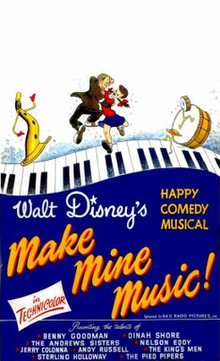
Make mine music poster.pngIn the mid 40s, Much of Disney’s staff was either drafted or called by the government to make training and propaganda films. The studio began releasing package film to keep the feature film division alive. As a result, Make Mine Music was released April 20, 1946. Made up of unrelated segments set to music, it starred The King’s Men, Nelson Eddy, Dinah Shore, Benny Goodman, The Andrews Sister, Jerry Colonna, Sterling Holloway, Andy Russell, David LIchine, Tania Riabouchnskaya, The Pied Pipers, and The Ken Darby Chorus. The film was also entered into the 1946 Cannes Film Festival.

The film has ten segments:
The Martins and the Coys features the radio group, King’s Men singing about a feud similar to the Hatfields and the McCoys. The feud is broken up with two young people from each side fall in love.
Blue Bayou, originally intended for Fantasia, uses Debussy’s Clair de Lune. Two egrets fly through the everglades on a moonlit night.
All the Cats Join In, where a pencil draws the action as it happens when 1940s teens are swept away by popular music.
Without You, which is a ballad of lost love.
Casey at the Bat, where Jerry Colonna recites the poem by Ernest Thayer.
Two Silhouettes, featuring ballet dancers moving in silhouette with animation backgrounds.
Peter and the Wolf, dramatizing the Prokofiev composition, with narration by Sterling Holloway. A Russian boy named Peter sets off into the forest to hunt a wolf with his animal friends. Each character is represented with a specific musical accompaniment.
After You’ve Gone, featuring Benny Goodman and the Goodman Octet. Eight instruments parade through a musical playgrond.
Johnnie Fedora and Alice Blue Bonnet, which is a romantic story of two hats who fall in in love in a department store. Alice is sold and Johnnie devotes himself to finding her again. They eventually do.
The Whale Who Wanted to Sjng at the Met, about a sperm whale with incredible musical talent and dreams of singing Grand Opera. The impresario Tetti-Tatti believes the whale has swallowed an opera singer and seeks to destroy the whale. He finds them and upon hearing him sing, Tetti-Tatti believes he swallowed three singers. He chases the whale with a harpoon and eventually manages to fire it. The whale is killed, but still sings in heaven. Nelson Eddy narrates and provided all the voices in the segment.

Fantasia Lite. That’s pretty much what Make Mine Music is. Not only are the shorts enjoyable to watch, but the music is also fun to listen to. It’s also an hour shorter than Fantasia.
On the other hand, where Fantasia at least had a connected plot of there being an orchestra performing a concert, Make Mine Music has no interconnected plot.

Final Call: While there is no connected plot, it’s enjoyable to watch. It will become #5

Thursday, April 3, 2014

Fantasia

So I’m in error. The Reluctant Dragon was released in 1941 and Fantasia was released in 1940. I should have watched Fantasia first. I’m also renaming the Edge of Enjoyment to the Edge of Satisfaction.
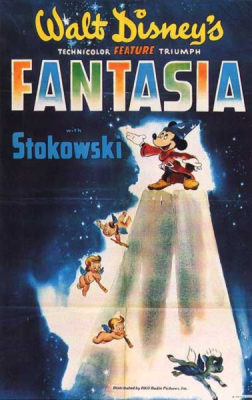
Anyway, Fantasia released November 13, 1940 is another hybrid film consisting of eight animated segments set to classical music. Leopold Stokowski directs the Philadelphia Orchestra and Deems Taylor introduced each segment as the Master of Ceremonies. The film was designed as a comeback for Mickey Mouse after he had declined in popularity and the Silly Symphonies shorts grew in theirs. While it was Disney’s first actual flop, it was rereleased in 1969, 1977, 1982, 1985, and 1990.

The film opens with the orchestra gathering and tuning their instruments in half-light, half-shadow against a blue background. Deems Taylor enters the stage and introduces the program.
Bach’s Toccata and Fugue in D Minor is first, portraying live action shots of the orchestra illuminated in blue and gold, backed by superimposed shadows, fade into abstract patterns. Animated lines, shapes, and cloud formations reflect the sound and rhythms of the music.
Next is Tchaikovsky’s Nutcracker Suite. Selections of the ballet suite are set to the changing of the seasons with a variety of dances by fish, fairies, flowers, mushrooms and leaves.
Then, it’s Paul Dukas’ The Sorcerer’s Apprentice, where Mickey Mouse is the young apprentice of sorcerer Yen Sid. He attempts to use some of his master’s magic to control the brooms into doing his chores, but is unable to control them.
Stravinsky’s Rite of Spring follows, presenting a visual history of Earth’s beginning’s, from the first living creatures to the reign and extinction of the dinosaurs.
After the intermission, there is a humorous demonstration of how sound is rendered on film, making the soundtrack a character.
Beethoven’s Pastoral Symphony plays while an ancient Greek world of centaurs, cupids, fauns and other mythological figures is portrayed. While gathering for a festival to honor Bacchus, Zeus interrupts and creates a storm, throwing lightning bolts at the attendees.
Afterwards, Amilcare Ponchielli’s Dance of the Hours plays as a comic ballet with Madame Upanova and her ostriches, Hyacinth Hippo and her servants, Elephanchine and her elephant troupe, and Ben Ali Gator and his troop of alligators. The finale has all of the characters dancing together until the palace collapses.
Finally, Mussorgsky’s Night on Bald Mountain and Schubert’s Ave Maria play as the devil Chernabog summons evil spirits and souls from their graves. They dance and fly through the air until the sound of an Angelus Bell rings, signaling night changing to dawn. A chorus sings Ave Maria as a line of robed monks walks with lighted torches through the forest and into the ruins of a cathedral.

I can see why this initially flopped. It’s basically an animated concert where the only thing that resembles a plot is Deems Taylor introducing the pieces. That being said, when coming into Fantasia knowing full well what it is, the film is quite good.
Having animation alongside famous classical pieces is great. It shows the animators’ thought processes and what they felt gave these pieces more life. The sequence with the soundtrack as a character is no only humorous, but also serves to show what sound looks like when it’s given a representation.

On the other hand, Fantasia is kind of long, just over two hours. It’s the normal amount of time for a concert. I can sit through concerts just fine and unless the story is slowly paced, length doesn’t bother me. However, it’s more than just a concert, it’s a concert juxtaposed with animation and it’s great. Unfortunately, every minute of those two hours trudges by. There’s a difference between watching a concert in a concert hall and watching it like this. It’s a great film, but it’s slow.

Final Call: a great film that juxtaposes animation with classical pieces, but you can feel every minute of it. It won’t make the Edge of Satisfaction, but it will be come #3.