Showing posts with label musical. Show all posts

Sunday, April 13, 2014

Make Mine Music

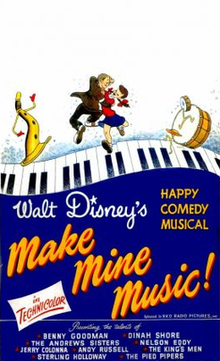
Make mine music poster.pngIn the mid 40s, Much of Disney’s staff was either drafted or called by the government to make training and propaganda films. The studio began releasing package film to keep the feature film division alive. As a result, Make Mine Music was released April 20, 1946. Made up of unrelated segments set to music, it starred The King’s Men, Nelson Eddy, Dinah Shore, Benny Goodman, The Andrews Sister, Jerry Colonna, Sterling Holloway, Andy Russell, David LIchine, Tania Riabouchnskaya, The Pied Pipers, and The Ken Darby Chorus. The film was also entered into the 1946 Cannes Film Festival.

The film has ten segments:
The Martins and the Coys features the radio group, King’s Men singing about a feud similar to the Hatfields and the McCoys. The feud is broken up with two young people from each side fall in love.
Blue Bayou, originally intended for Fantasia, uses Debussy’s Clair de Lune. Two egrets fly through the everglades on a moonlit night.
All the Cats Join In, where a pencil draws the action as it happens when 1940s teens are swept away by popular music.
Without You, which is a ballad of lost love.
Casey at the Bat, where Jerry Colonna recites the poem by Ernest Thayer.
Two Silhouettes, featuring ballet dancers moving in silhouette with animation backgrounds.
Peter and the Wolf, dramatizing the Prokofiev composition, with narration by Sterling Holloway. A Russian boy named Peter sets off into the forest to hunt a wolf with his animal friends. Each character is represented with a specific musical accompaniment.
After You’ve Gone, featuring Benny Goodman and the Goodman Octet. Eight instruments parade through a musical playgrond.
Johnnie Fedora and Alice Blue Bonnet, which is a romantic story of two hats who fall in in love in a department store. Alice is sold and Johnnie devotes himself to finding her again. They eventually do.
The Whale Who Wanted to Sjng at the Met, about a sperm whale with incredible musical talent and dreams of singing Grand Opera. The impresario Tetti-Tatti believes the whale has swallowed an opera singer and seeks to destroy the whale. He finds them and upon hearing him sing, Tetti-Tatti believes he swallowed three singers. He chases the whale with a harpoon and eventually manages to fire it. The whale is killed, but still sings in heaven. Nelson Eddy narrates and provided all the voices in the segment.

Fantasia Lite. That’s pretty much what Make Mine Music is. Not only are the shorts enjoyable to watch, but the music is also fun to listen to. It’s also an hour shorter than Fantasia.
On the other hand, where Fantasia at least had a connected plot of there being an orchestra performing a concert, Make Mine Music has no interconnected plot.

Final Call: While there is no connected plot, it’s enjoyable to watch. It will become #5

Thursday, April 3, 2014

Fantasia

So I’m in error. The Reluctant Dragon was released in 1941 and Fantasia was released in 1940. I should have watched Fantasia first. I’m also renaming the Edge of Enjoyment to the Edge of Satisfaction.
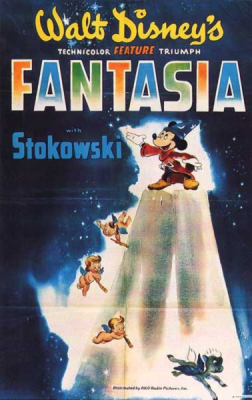
Anyway, Fantasia released November 13, 1940 is another hybrid film consisting of eight animated segments set to classical music. Leopold Stokowski directs the Philadelphia Orchestra and Deems Taylor introduced each segment as the Master of Ceremonies. The film was designed as a comeback for Mickey Mouse after he had declined in popularity and the Silly Symphonies shorts grew in theirs. While it was Disney’s first actual flop, it was rereleased in 1969, 1977, 1982, 1985, and 1990.

The film opens with the orchestra gathering and tuning their instruments in half-light, half-shadow against a blue background. Deems Taylor enters the stage and introduces the program.
Bach’s Toccata and Fugue in D Minor is first, portraying live action shots of the orchestra illuminated in blue and gold, backed by superimposed shadows, fade into abstract patterns. Animated lines, shapes, and cloud formations reflect the sound and rhythms of the music.
Next is Tchaikovsky’s Nutcracker Suite. Selections of the ballet suite are set to the changing of the seasons with a variety of dances by fish, fairies, flowers, mushrooms and leaves.
Then, it’s Paul Dukas’ The Sorcerer’s Apprentice, where Mickey Mouse is the young apprentice of sorcerer Yen Sid. He attempts to use some of his master’s magic to control the brooms into doing his chores, but is unable to control them.
Stravinsky’s Rite of Spring follows, presenting a visual history of Earth’s beginning’s, from the first living creatures to the reign and extinction of the dinosaurs.
After the intermission, there is a humorous demonstration of how sound is rendered on film, making the soundtrack a character.
Beethoven’s Pastoral Symphony plays while an ancient Greek world of centaurs, cupids, fauns and other mythological figures is portrayed. While gathering for a festival to honor Bacchus, Zeus interrupts and creates a storm, throwing lightning bolts at the attendees.
Afterwards, Amilcare Ponchielli’s Dance of the Hours plays as a comic ballet with Madame Upanova and her ostriches, Hyacinth Hippo and her servants, Elephanchine and her elephant troupe, and Ben Ali Gator and his troop of alligators. The finale has all of the characters dancing together until the palace collapses.
Finally, Mussorgsky’s Night on Bald Mountain and Schubert’s Ave Maria play as the devil Chernabog summons evil spirits and souls from their graves. They dance and fly through the air until the sound of an Angelus Bell rings, signaling night changing to dawn. A chorus sings Ave Maria as a line of robed monks walks with lighted torches through the forest and into the ruins of a cathedral.

I can see why this initially flopped. It’s basically an animated concert where the only thing that resembles a plot is Deems Taylor introducing the pieces. That being said, when coming into Fantasia knowing full well what it is, the film is quite good.
Having animation alongside famous classical pieces is great. It shows the animators’ thought processes and what they felt gave these pieces more life. The sequence with the soundtrack as a character is no only humorous, but also serves to show what sound looks like when it’s given a representation.

On the other hand, Fantasia is kind of long, just over two hours. It’s the normal amount of time for a concert. I can sit through concerts just fine and unless the story is slowly paced, length doesn’t bother me. However, it’s more than just a concert, it’s a concert juxtaposed with animation and it’s great. Unfortunately, every minute of those two hours trudges by. There’s a difference between watching a concert in a concert hall and watching it like this. It’s a great film, but it’s slow.

Final Call: a great film that juxtaposes animation with classical pieces, but you can feel every minute of it. It won’t make the Edge of Satisfaction, but it will be come #3.


Saturday, March 29, 2014

Snow White and the Seven Dwarfs

Before I begin with this, I have to make note of how I said I was doing every movie put out by Disney and their subsidiaries. I retract this statement. I made my list and realized that’s well over 1,000 films. Too much for one series. So I’ll break it up into chunks. First it will be Disney Animated Canon, Pixar, Ghibli, and the hybrids. Significantly less.

Anyway, Snow White and the Seven Dwarfs, released December 21, 1937. It was based on the Brothers Grimm tale and was the first full-length cel animated feature film. It made $8 million worldwide.

In a storybook prologue, Snow White is a princess living with her stepmother, she fears Snow White's beauty surpassing hers, and forces her to work as a scullery maid. She asks her Magic Mirror daily "who is the fairest one of all." For several years the mirror always answered that the Queen was. However, as the film opens, the Magic Mirror informs the Queen that Snow White is now the fairest in the land. The Queen orders a huntsman to take Snow White into the forest and kill her, demanding he return with Snow White's heart in a jeweled box. The huntsman encounters Snow White but decides not to harm her. He begs for her forgiveness, reveals the Queen wants her dead, and urges her to flee into the woods and never come back, bringing back a pig's heart instead. 

Running through the woods lost and frightened, the princess is befriended by woodland creatures who lead her to a cottage deep int he woods. Finding seven small chairs in the cottage's dining room, Snow White assumes the cottage is the untidy home of seven orphaned children. It soon becomes apparent that the cottage instead belongs to seven adult dwarfs: Doc, Grumpy, Happy, Sleepy, Bashful, Sneezy, and Dopey, who work in a nearby mine. Returning home, they are alarmed to find their cottage clean and surmise that an intruder has invaded their home. The dwarfs find Snow White upstairs, asleep across three of their beds. Snow White awakes to find the Dwarfs at her bedside and introduces herself, and all of the dwarfs eventually welcome her into their home after they learn she can cook and clean. She keeps house for the dwarfs while they mine for jewels and at night sing, play music, and dance.

Meanwhile the Queen discovers that Snow White is still alive when the mirror again answers that Snow White is the fairest int he land. Using magic to disguise herself as an old hag, the Queen creates a poisoned apple, explaining that Snow White would collapse into a magical sleep if she were to take even a single bite of the apple. The sleep can only be cured by the power of "loves first kiss." the Queen reasons that this is no danger to her plans as the dwarfs would not be able to awaken Snow White and would think she was dead, resulting in her being buried alive. The Queen goes to the cottage while the dwarfs are away and tricks Snow White into biting the poisoned apple. As Snow White falls asleep, the Queen proclaims that she will be the fairest of the land. The dwarfs are alerted by the woodland animals who recognize the queen, chase her off a cliff and trap her. She tries to roll a boulder over them, but before she can do so, lightning strikes the cliff, causing her to fall to her death.

The dwarfs return to their cottage and find Snow White seemingly dead, being kept in a deathlike slumber by the poison. Unwilling to bury her out of sight in the ground, they instead place her in a glass coffin trimmed with gold in a clearing in the forest. Together with the woodland creatures, they keep watch over her in an "eternal vigil." After some time, a prince who had previously met and fallen in love with Snow White, learns of her eternal sleep and visits her coffin. Saddened by her apparent death, he kisses her, which breaks the spell and awakens her. The dwarfs and animals all rejoice as the Prince takes Snow White to his castle, which glows in her presence.
It’s honestly a good movie, especially for its time. While the visuals aren’t anything to write home about today, they were the best looking in 1937, especially since this was the first animated feature ever. The soundtrack is pretty good too. Granted, Adriana Caselotti’s singing might be a little ear shattering, but they’re still good songs. With well-remembered songs such as I’m Wishing, Whistle While You Work, Heigh Ho and Someday my Prince Will Come, it’s a solid soundtrack. In regards to characterization, it’s the dwarfs that save it. Especially Grumpy, who ends up softening towards the end of the film, because Character Development is always a good thing. Other than that, the evil queen is evil, the prince shows up at the beginning and end and Snow White… exists.
The story is good too, but then, if anyone doesn’t know the Disney version of Snow White, then they don’t deserve to have internet. I haven’t read the original fairy tale, but I do know the Queen is made to dance in red hot shoes. Makes me want to read it. Anyway, the one problem: Why do they encase her in a glass coffin instead of burying her? I know it’s because they don’t want to bury her because they won’t see her anymore, but still you ever see a corpse after a few days?

Final Call: Fun film with great music, a good story and lively secondary characters. It obviously starts off as #1 and breaks the Edge of Enjoyment

Sunday, February 23, 2014

The Great Ziegfeld

File:The Great Ziegfeld poster.gif

In the year where Mr. Deeds Goes to Town is nominated for Best Picture, it loses to The Great Ziegfeld. Directed by Robert Z. Leonard and starring William Powell, Myrna Loy, and Louise Rainer, the film is a musical that does tribute to Broadway impresario Florenz Ziegfeld Jr. The film is notable for being the first musical to have a cast member win an award (Louise Rainer for Best Actress) and remains the standard for musical production. The final cut took 16 reels of film and the production itself employed more than 1,000 people.

The film begins as Florenz Ziegfeld Jr. (Powell), the son of a highly respected music professor, is promoting Eugen Sandow, the world’s strongest man, at the 1893 Chicago World’s Fair. By allowing women to feel Sandow’s muscles, Ziegfeld is able to overcome his competition and becomes the most popular attraction. When the World’s Fair is over, Ziegfeld returns to his father and his student, Mary Lou at the University of Music and Theatre Leipzig before going to San Francisco with Sandow. There, the two are mocked as frauds for a show where Sandow faces a lion that falls asleep as soon as the show begins.

Putting San Francisco behind him, Ziegfeld travels to England where he runs into his friendly rival, Billings who is on his way to sign a contract with French Star, Anna Held (Rainer). Even though he lost all his money at Monte Carlo, Ziegfeld is able to charm Anna into signing with him, despite almost being sent away twice for being rude and broke.  she reveals that she appreciates his honesty and Ziegfeld promises to give her more publicity than she can possibly dream of and to feature her alongside America’s most prominent theatrical performers.

Anna’s first performance is not a success. But Ziegfeld manages to gain publicity by sending 20 gallons of milk to Anna every day for a fake milk bath beauty treatment and refusing to pay for it. The headlines bring the curious to his theatre and Ziegfeld introduces eight new performers to back Anna. Ziegfeld then sends her flowers and jewelry with a note calling her his wife. She agrees to marry him.

Ziegfeld then gets an idea for a new show that will glorify the American girl, featuring a cast of blondes and brunettes. The production is filled with beautiful women and extravagant costumes and sets. It turns out to be a hit and Ziegfeld produces more versions of his “Follies.” He tries to make a star out of alcoholic Audrey Dane (Virginia Bruce) and lures Fanny Brice (as herself) out of vaudeville. Stagehand Ray Bolger (also himself) is given a chance to star as well. Mary Lou, now grown, visits Ziegfeld and is hired as a dancer. Anna becomes envious of the new production as well as the attention given to Audrey. She divorces Ziegfeld after walking in on him and a drunken Audrey at the wrong moment. Audrey then walks out on the show after the confrontation. Broke, Ziegfeld borrows money from Billings and then meets Billie Burke (Loy), who he marries. Anna calls Ziegfeld and pretends to be glad for him. Eventually he and Burke have a daughter named Patricia.

After a while of success, the public’s taste change and Ziegfeld starts to get negative reviews. In a barber’s shop, he hears three men saying he’ll never produce another hit, which causes him to vow four hits on Broadway at the same time. The goal is a success at first, but when he invests over a million in the stock market, he loses it all in the Crash of 1929. This bankrupts him and forces Burke to return to the stage.

With the growing popularity of film over live shows, Ziegfeld is shaken by his reversal of fortune and becomes ill. Billings visits and the two agree to become partners in a new, grander version of The Ziegfeld Follies, but both men are broke and Ziegfeld knows this. The film ends with Ziegfeld his apartment overlooking the Ziegfeld theatre in a delirium, recalling scenes of his hits. He exclaims his continuing mantra of ‘more steps’ before dying.
File:Photo from The Great Ziegfeld 1936.jpg 
Visuals. This film thrives on its visuals. And they’re really good, but after a while, you kind of get sensory overload and wish the plot would start continuing again. For instance, the picture to the right is a part of one of the performance sequences. Looking at this as a number would certainly be eye-catching and wonderful. But the sequence is about 10-15 minutes long. And there are three of them. Combine that with a three hour long film that just drags on and you see the problem.  

On the other hand, the music of these numbers itself was pretty good and the plot wasn’t bad when it was moving. It’s just that it barely moved.

I’m going to guess this got Best Picture for reminding Hollywood of “the good old days.”


Final Call: Mr. Deeds Goes to Town got robbed. Good music and acting can’t save a film that is unnecessarily long and excessively flamboyant. It fails to avoid the Edge of Dissatisfaction and goes at #5 under All Quiet on the Western Front